
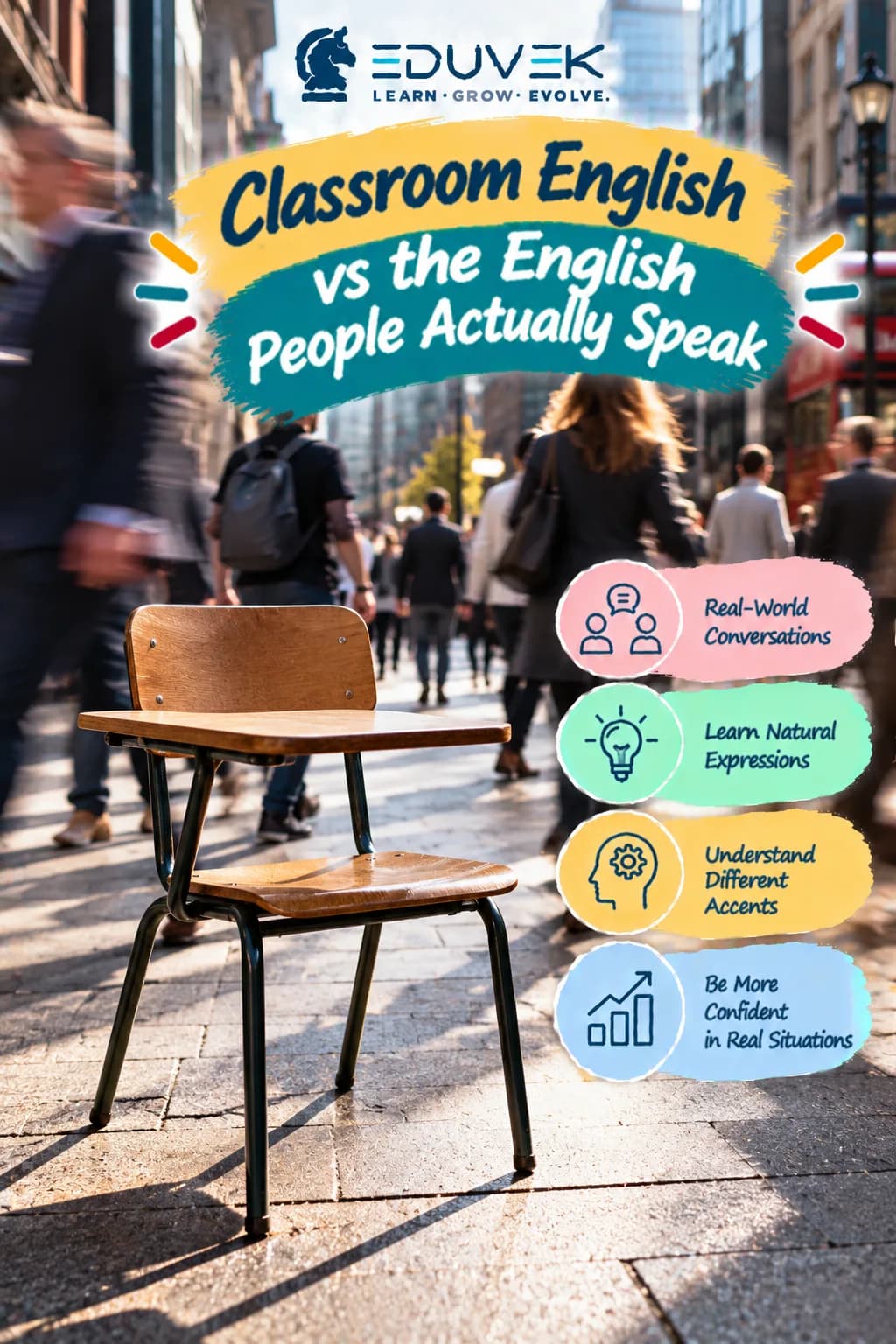
Many learners arrive in an English-speaking environment with good exam results and discover they can't follow a conversation between two colleagues. Nothing was taught wrong. Classroom English is a simplified, clarified version of the language, and the distance between it and ordinary speech is larger than most courses admit.
What's different about real speech
It's joined up. What do you want to do comes out as something closer to whaddaya wanna do. Learners listening for the words they studied don't hear them, because in connected speech those words have merged.
This is the single biggest source of the "I studied for years and can't understand anyone" experience. It isn't vocabulary. It's that you learned the words in their careful form and people say them in their fast form.
It's incomplete. People start sentences again, trail off, interrupt, answer a different question. Classroom dialogue is tidy; conversation is not.
It's full of fillers. Like · you know · I mean · sort of · kind of. Taught as bad style, used constantly, and they do real work — holding the floor, softening, signalling. Speech without them sounds oddly formal.
It's idiomatic. Ordinary conversation runs on phrases whose meaning isn't in the words: touch base · run it past · a bit much · fair enough · I'm not going to lie.
It's regional. Courses teach one accent. The world speaks hundreds, and most English conversations now happen between people who both learned it as a second language.
What the classroom gets right
Worth saying, because the conclusion isn't that lessons are useless.
Grammar is better learned explicitly than inferred. Vocabulary in clear form first is sensible — you need the careful version to recognise the fast one. And a structured path is far more efficient than hoping exposure sorts it out.
The problem isn't the classroom. It's stopping there.
Closing the gap
Unscripted conversation with a person. Not a dialogue, not a recording. Someone who speaks at normal speed, interrupts, and uses the phrases they'd use with anyone.
Content made for native speakers. Podcasts, radio, television, people talking to each other rather than to learners. Harder, and it's the actual target.
Ask what things mean. Learners frequently nod through phrases they don't know. Sorry, what does "touch base" mean? is a completely normal question and the fastest way to collect the idiom nobody teaches.
Learn to hear the reductions. Gonna · wanna · gotta · dunno · lemme · whatcha. You don't have to say them. You do have to recognise them, because they constitute a large share of what you'll hear.
What not to conclude
That your English is bad. Following rapid conversation between first-language speakers is one of the hardest things in the language, and it comes last — after reading, writing and speaking.
Finding it difficult is not a sign that something went wrong. It's the normal order.