
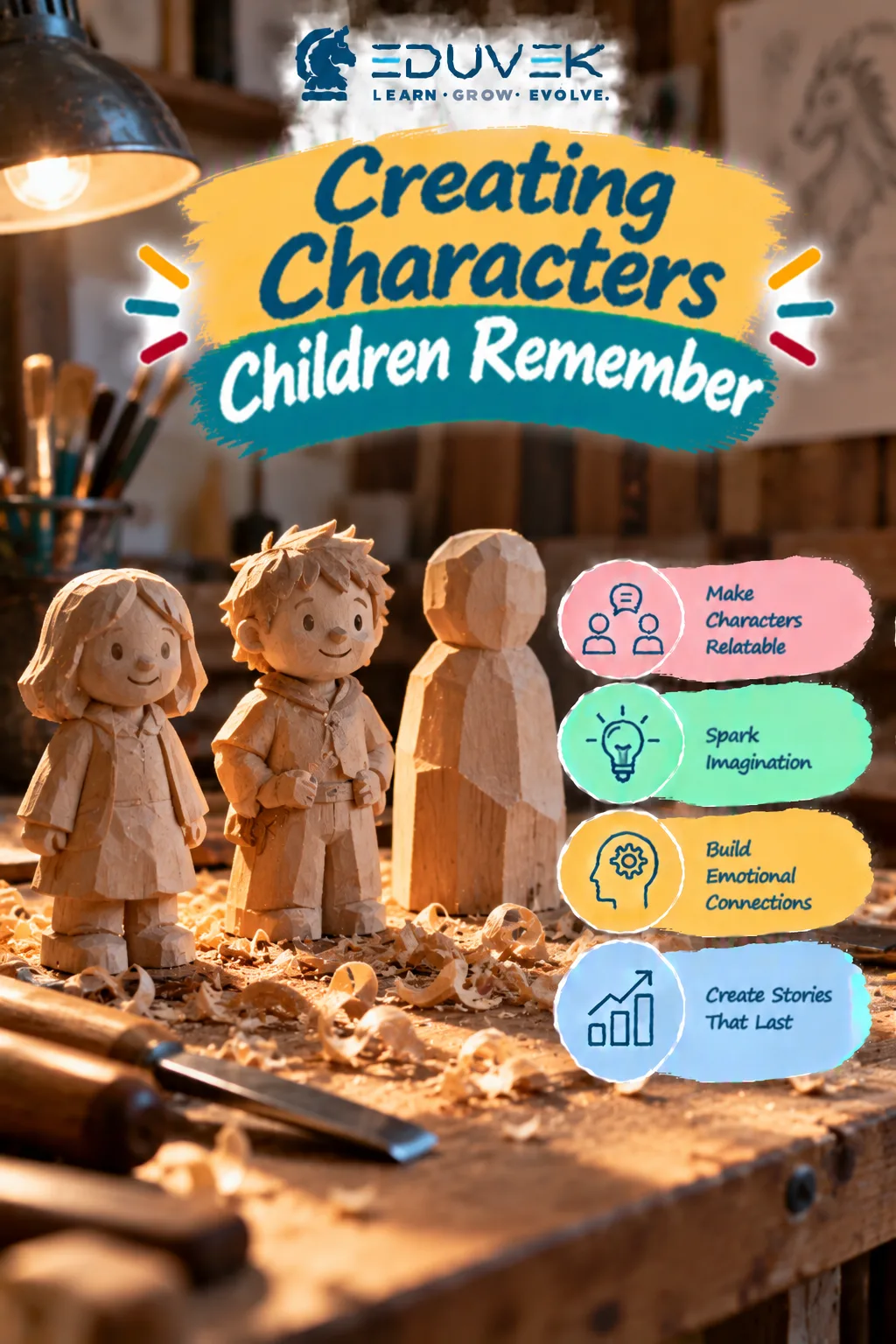
The characters children remember are rarely the nicest ones. They're specific, they want something unreasonably, and they're allowed to be difficult — which is exactly what first-time authors tend to sand off.
Wanting something is the whole engine
A character who wants something precise is a story. A character with a nice personality is a description.
And the want has to be concrete, because young readers don't engage with abstractions. Not to be brave — to get the ball back from the roof. Not to make friends — to be invited to the birthday party. The abstract version can be what the book is about; it can't be what the character is chasing.
Let them be flawed
Manuscripts frequently feature pleasant, helpful, well-behaved protagonists, usually because the author is conscious that children are reading.
Children don't want to read about well-behaved children. The protagonists that last are stubborn, greedy, frightened, jealous, boastful or furious. Being difficult is what makes a character interesting, and it's what lets them change.
A flaw also solves a structural problem: it gives the story something to be about beyond the external obstacle.
Specificity over description
The temptation is to describe a character fully. What works is one or two exact details that imply the rest.
A girl who keeps a list of everything that's unfair. A boy who won't take off his bicycle helmet indoors. A bear who's terrible at apologising.
One precise detail does more than a paragraph of general characterisation, and it gives an illustrator something to build on — which matters enormously in a picture book, where your character will be drawn by someone you've never met.
Agency, consistently
The protagonist must do the thing. Not be rescued, not be instructed, not have the situation resolve around them.
This is worth checking literally: go through your manuscript and mark every action by the main character. If the significant ones belong to adults or to coincidence, that's the revision.
How children recognise themselves
Not through characters like them in the obvious sense, but through feelings they recognise — being left out, wanting something badly, being blamed unfairly, not being believed.
That's why animal characters, monsters and inanimate objects work so well. The surface can be anything as long as the emotion is accurate.
Names
Say them out loud repeatedly, because an adult will. Short, distinctive and easy to pronounce beats clever. Avoid two characters whose names start with the same sound, which is confusing read aloud.
Series characters
If you're hoping for more than one book, the character needs a trait that generates stories rather than one that resolves. A curiosity, an obsession, a particular way of getting things wrong — something that will cause trouble again in a different setting.
The test
Describe your protagonist in one sentence without using an adjective about their personality. If you can't say anything beyond kind and curious, the character isn't built yet.