
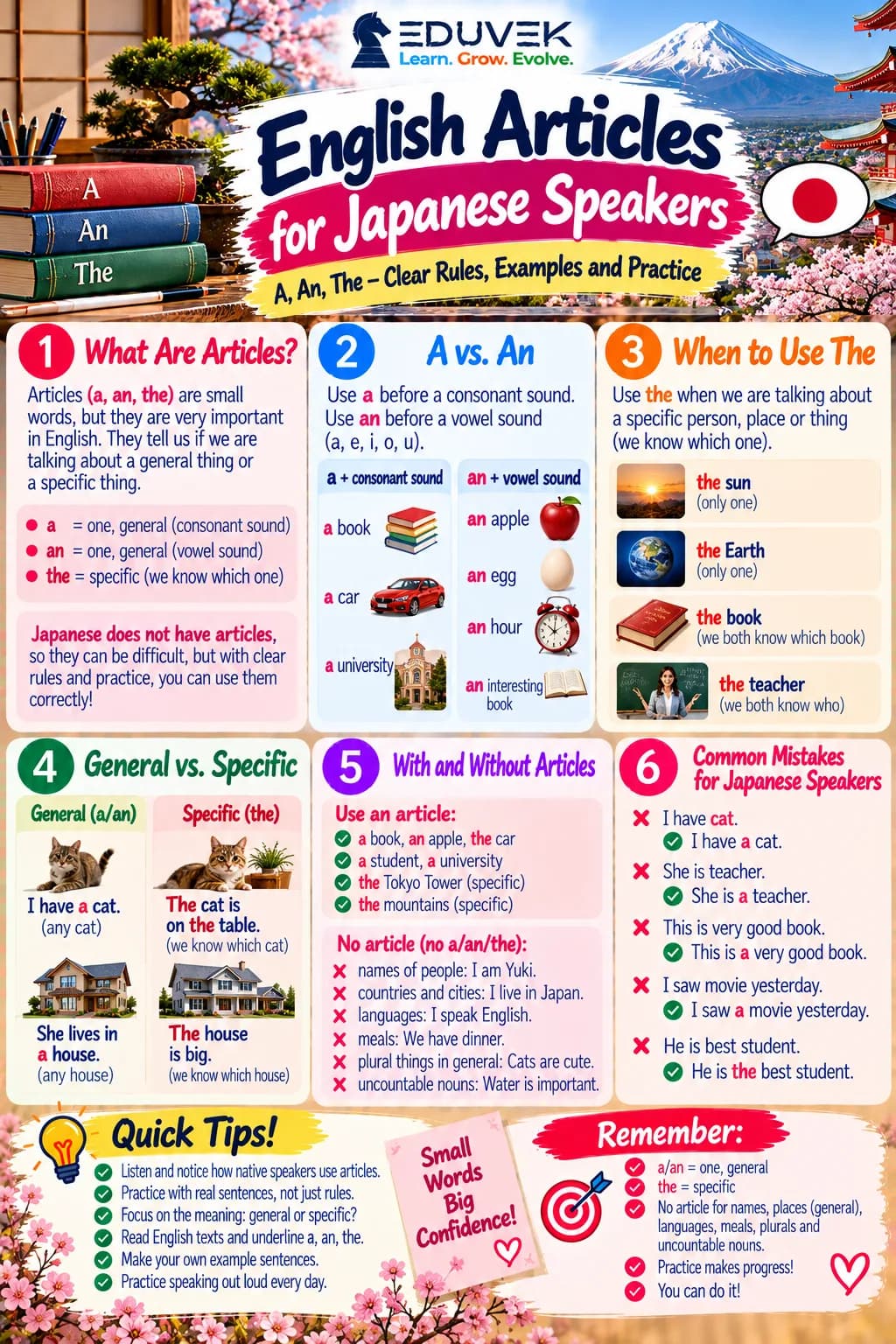
Articles — a, an, the — are one of the last things to click for Japanese learners, and that's completely normal. Japanese doesn't have them at all, so there's no equivalent in your first language to lean on.
Most learners don't struggle because articles are hard to understand; they struggle because nothing in Japanese ever asked them to make this choice before. Once you see what the choice actually is, the fog starts to lift.
Why articles feel invisible
Japanese marks nouns through particles and context, and a bare noun — hon — can mean "a book," "the book," "books," or "the books" depending entirely on the situation. English refuses to let you stay vague: almost every singular countable noun has to announce whether it's a book or the book. So you're not learning a new word to memorise — you're learning to make a small decision English forces and Japanese never did.
"A / an" — one of many, new to the listener
Use a (or an) the first time you bring up a single, countable thing the other person doesn't know about yet: I saw a dog. She sent me an email. It signals "one of these, and this is new information." An is simply a before a vowel sound — an hour, a university — a pronunciation rule, not a spelling one, which trips up even advanced learners.
"The" — we both already know which one
Switch to the when the thing is specific and shared: it was already mentioned (I saw a dog. The dog was huge.), it's obvious from context (Close the door.), or there's only one (the sun, the station near my house). A good test: if both you and the listener could point to the same thing, it's almost always the.
When you use no article at all
Talking about things in general — plural countables and uncountable nouns — usually takes nothing: Dogs are loyal. I like coffee. Water is cheap here. This "zero article" is a real, deliberate choice, and for Japanese learners it's often the most natural one to reach for, because it's closest to the article-free habit you already have. The trap is using it where English wants a or the.
The specific traps Japanese learners hit
Three recur. Overusing "the" for general statements (I like the music when you mean music in general). Dropping articles in a first mention (I bought car instead of a car), because the Japanese instinct is to leave the noun bare. And countable vs uncountable surprises — information, advice, furniture take no a in English even though they feel countable. These aren't signs you're bad at grammar; they're exactly the places where English and Japanese disagree.
A habit that beats memorising rules
Don't chase perfect articles sentence by sentence — you'll freeze. Instead, notice articles in everything you read, and copy natural phrases whole: at the office, take a break, go to work, on the train. Your ear will start to find the wrong ones strange long before you can explain the rule. Articles are a slow win, and listeners understand you perfectly while you're still getting them right — so use English now and let accuracy grow from exposure.