
Most people learning Lebanese Arabic aren't in Lebanon, and many aren't near a Lebanese community either. That's a real constraint and a smaller one than it used to be — but it does mean every bit of practice has to be arranged deliberately, because none of it will happen by accident.
The specific problem with this language
Lebanese is harder to self-study than most languages, for structural reasons rather than difficulty.
There's no standardised written form, so materials spell things inconsistently. Published resources are thinner than for MSA or for major European languages. Apps mostly teach MSA, which isn't what you want. And media is plentiful but pitched at native speakers, with little in between.
Which means the usual advice — get a good course and work through it — doesn't apply as cleanly here. A teacher does more of the work in Lebanese than in a language with an established self-study path.
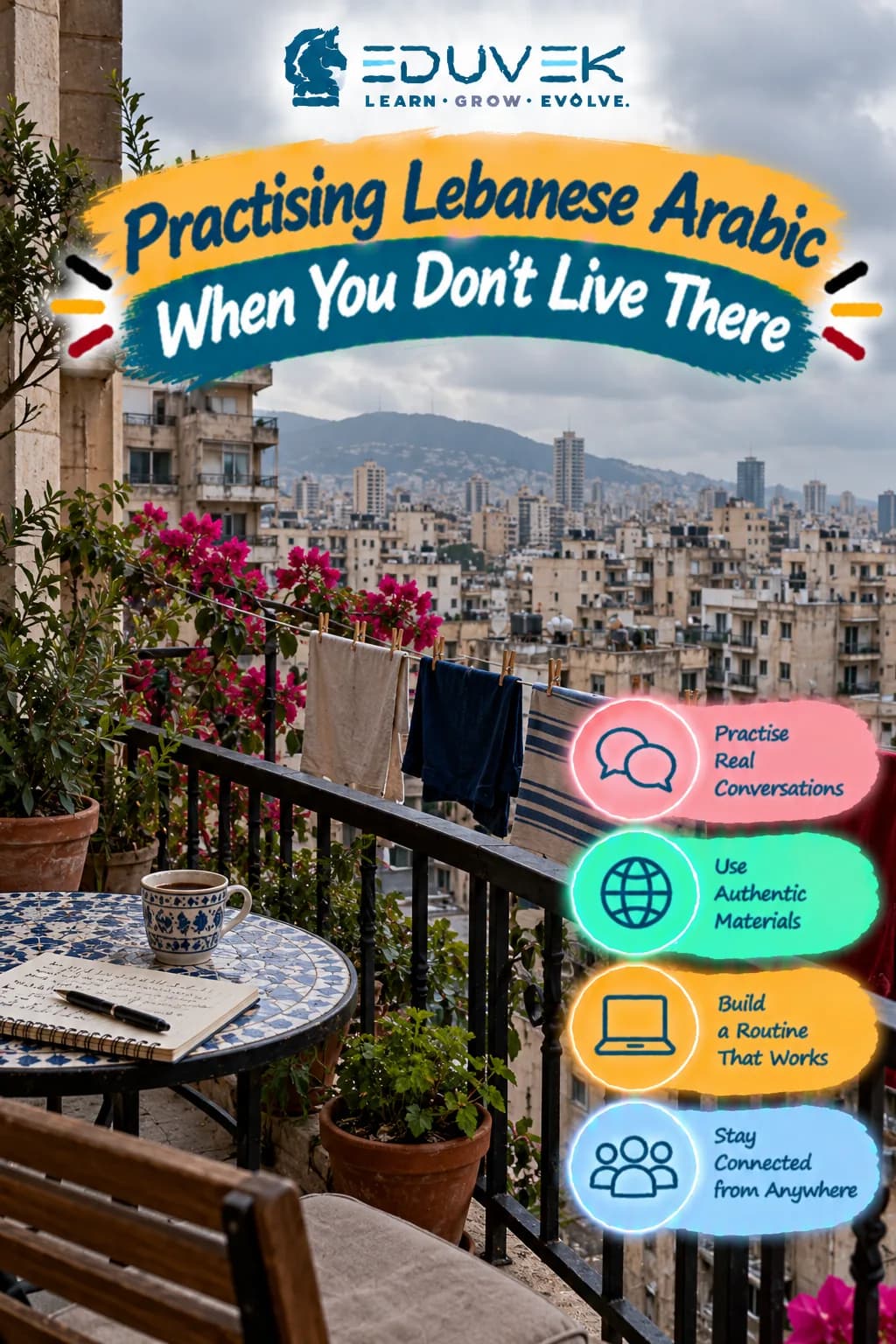
What works from a distance
Regular lessons with a Lebanese speaker. The core of it, and more central than in most languages for the reasons above. One or two hours a week of real conversation with correction.
Media you'd watch anyway. Lebanese television, music and online video. Lebanese media circulates widely across the Arab world, so there's a lot of it. Use it for ear training rather than study — the goal is becoming accustomed to real speed and real sound.
Voice messages. Genuinely useful and underused. If you have family or friends who speak it, voice notes let you practise production with no time pressure, and you can re-record. Lower stakes than a call and more useful than text.
One recurring conversation. A weekly call with a relative, a friend, anyone. The single most valuable thing after lessons, and the thing people put off because the first few are uncomfortable.
What doesn't work
Apps, mostly. Few teach Lebanese, and those that teach Arabic generally teach MSA. Useful for the script if you want it; not a route to spoken Lebanese.
Passive listening alone. Background Lebanese radio builds a little familiarity and no production.
Waiting for a trip. A fortnight in Beirut is a wonderful accelerator for someone who already speaks a little, and it isn't a substitute for the year beforehand.
If there's a community near you
Worth checking properly — Lebanese diaspora communities are significant in Canada, Australia, Brazil, France, the United States and elsewhere, and they're often larger and more organised than people assume. Churches, community associations, restaurants, cultural events.
The same obstacle applies as everywhere: everyone will switch to English. You'll have to ask them not to, more than once.
The realistic arrangement
Lessons weekly, media most days, one real conversation a week, and voice messages in between.
That's a few hours total, it's all arrangeable from anywhere, and it's considerably more than most people living in Lebanon with no study routine actually accumulate. Location is less decisive than it feels.