
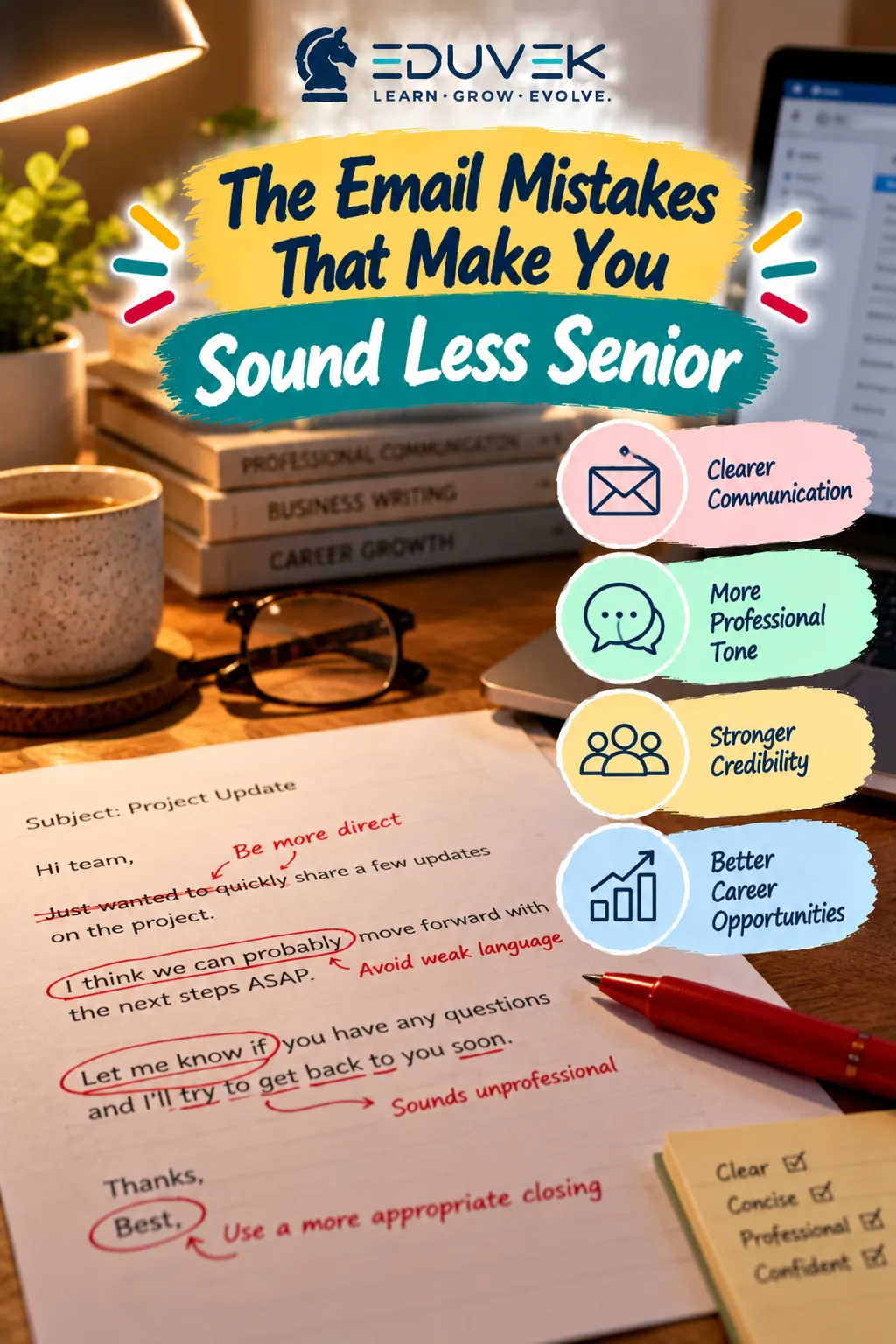
Your email is probably grammatically fine. What's costing you isn't errors — it's a set of habits that are taught as polite, read as junior, and quietly shape how seriously your messages are taken.
Apologising for existing
Sorry to bother you · Apologies for the long email · Sorry for the delay in getting back to you.
Each of these is doing nothing except lowering your own standing before you've said anything. You are not bothering anyone by doing your job. Delete the apology and start with the subject.
If you genuinely need to acknowledge a delay, Thanks for your patience does the same work without the self-demotion.
Burying the ask
Many second-language writers build to the request: context, background, reasoning, and then — in the final line — what they actually want.
English professional email runs the other way. The ask goes first, then the reasoning for whoever needs it. A reader who has to reach paragraph four to find out what you need will frequently not reach paragraph four.
Over-hedging
I was just wondering if it might possibly be feasible to perhaps look at this sometime next week if that's not too much trouble.
Hedging is taught as politeness, and in small doses it is. Stacked, it makes the request sound optional, which means it gets treated as optional.
Could you look at this by Thursday? is polite. It is also answerable.
Mismatched formality
Dear Sir/Madam to a colleague, or Yours faithfully on an internal thread, reads as someone applying a textbook to a situation it wasn't written for.
Most English-speaking workplaces run on Hi [name] and Thanks or Best. Matching what the other person uses is a reliable guide — if they opened with Hi Yulia, you're not writing back to Dear Ms.
Subject lines that say nothing
Question · Quick one · Following up tell the reader nothing and get opened last.
Budget approval needed by Friday tells them what it is, what's required, and when. That's the whole job of a subject line.
Thanking in advance
Thanks in advance for your help is extremely common and lands badly with some readers, because it thanks them for agreeing to something they haven't agreed to yet.
Thanks at the end, or nothing, is safer.
The underlying pattern
Almost all of these come from the same place: a belief that more softening is more professional. In English business writing the opposite is usually true. Clear and direct reads as competent and respectful of the reader's time; heavily softened reads as uncertain.
Directness isn't rudeness. That distinction is genuinely difficult if your first language encodes politeness differently, and it's one of the most useful things to work on explicitly.