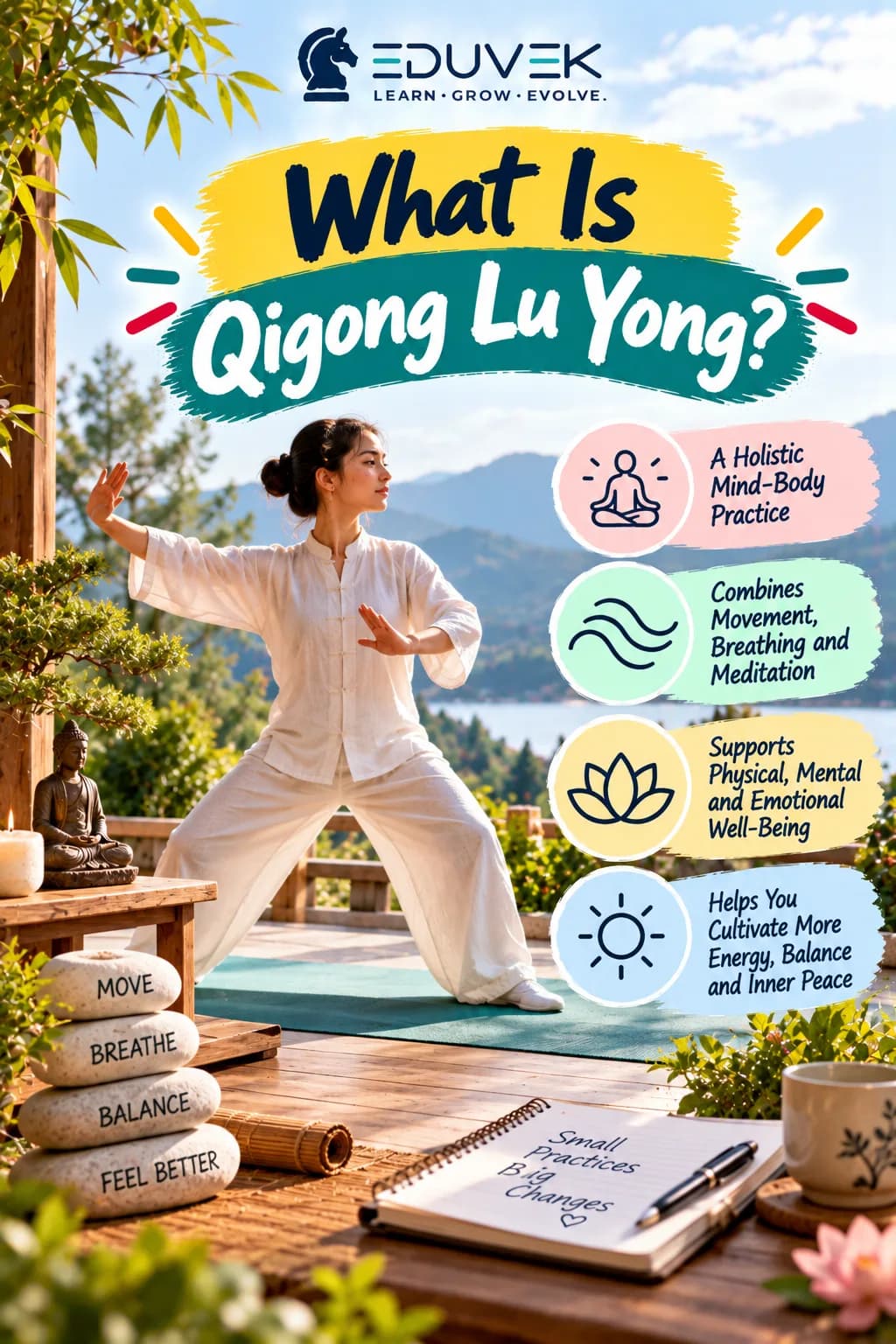
Qigong is a family of Chinese practices combining slow movement, breathing and attention, developed over centuries and now practised worldwide. Lu Yong is one named form within that family, taught as a sequence of gentle movements accessible to people of most ages and fitness levels.
What qigong is, broadly
Slow, deliberate movement coordinated with breath. Less demanding than most exercise, much slower than most, and usually performed standing.
In its traditional framing it's described in terms of energy — qi — and its circulation. You can engage with that framework or not; many practitioners treat it as a useful way of describing attention and sensation rather than a claim about physics, and the practice works the same either way.
The Lu Yong form
Lu Yong is a form taught within the methods of Samadeva — a specific sequence of gentle movements, typically working the spine, joints and overall mobility, learned progressively. Qigong as a tradition goes back centuries; Lu Yong is the particular sequence in which these principles are taught here.
What a session involves
Standing movement, slow and repeated, with attention to breathing. Little or no floor work in most forms, which makes it accessible to people who find getting up and down difficult.
No special equipment, no particular clothing, and enough space to extend your arms.
Who it suits
People who want movement without strain. Older adults, for whom the gentleness and the balance element are both relevant. People recovering from illness or a period of inactivity. People who find seated meditation difficult and do better with something physical.
It's also undemanding enough to do daily, which is a large part of its value.
What the evidence supports
Research on qigong and tai chi is reasonably encouraging for balance and fall prevention in older adults, and there's supportive work on general wellbeing and quality of life.
Claims beyond that — curing disease, treating specific conditions — go well past what the evidence shows, and should be treated with the scepticism they deserve wherever they appear.
Learning it
Learnable from video, but the corrections are the point, and nobody can see their own alignment. Learning with a teacher first, then practising alone, is the usual route — and online instruction works well for this, because the movements are slow and visible on camera.