
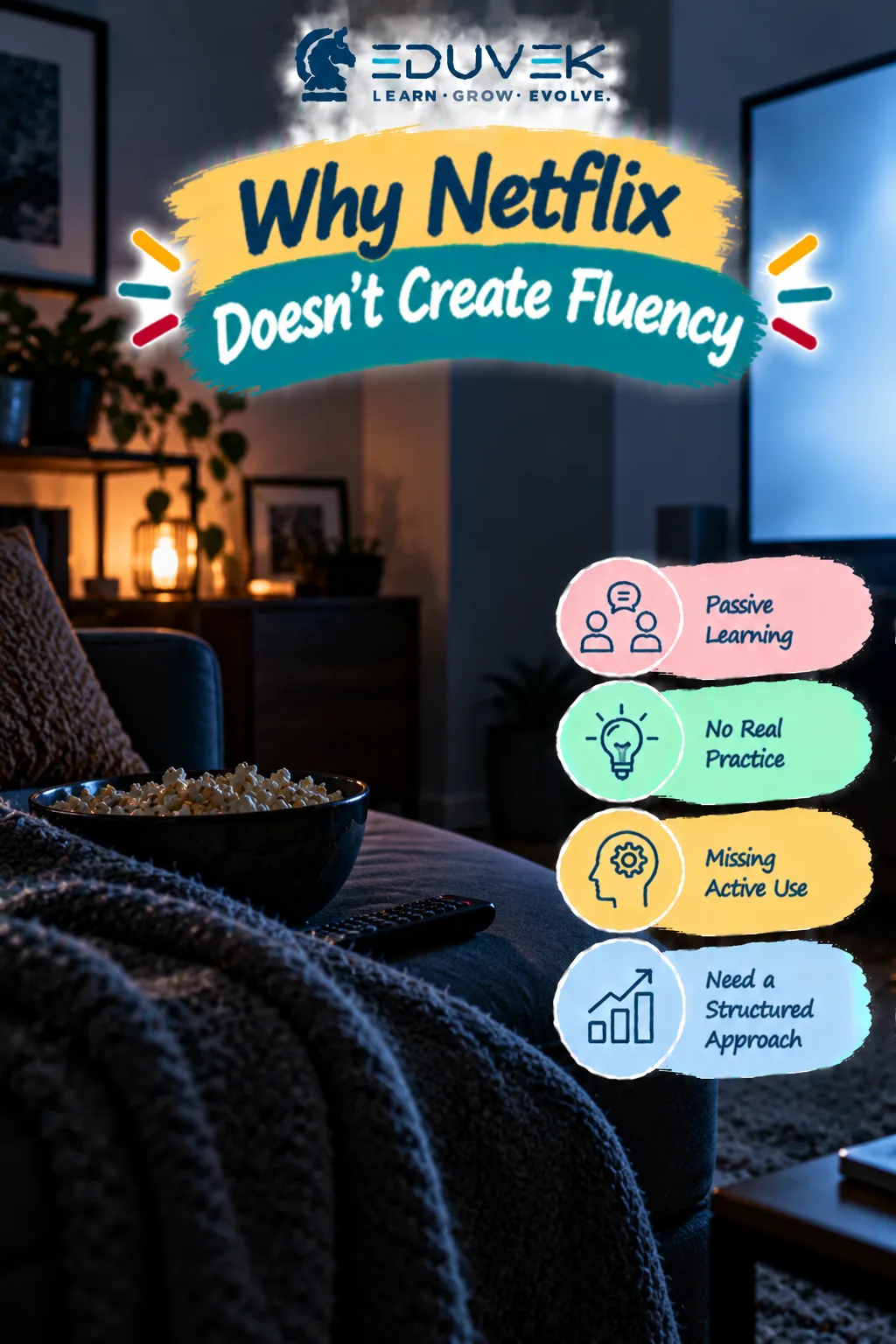
Watching English television is one of the most enjoyable things you can do for your English, and one of the least efficient. It genuinely helps with some things and does almost nothing for others, and knowing which is which saves people a lot of disappointed effort.
What it's good for
Listening at natural speed. Real speech, with contractions, overlapping dialogue and people not finishing sentences. Textbook audio is recorded for learners; television is not, and that gap is where a lot of comprehension difficulty lives.
Accents and variety. Dozens of different speakers rather than one careful narrator.
Register and idiom. How people actually speak to each other — what's rude, what's affectionate, what's sarcastic. Difficult to learn any other way.
Keeping the language present. Something in English most days, with no willpower required.
All real. None of it is fluency.
What it can't do
Fluency is production. Watching is reception, and reception does not convert into production on its own.
You can reach the point of following a series comfortably without subtitles and still be unable to hold a five-minute conversation. That isn't a contradiction — they're separate abilities, and you've been practising only one.
There's also no feedback. Nothing you watch tells you that your word order is wrong or that you've been mispronouncing something for years. Errors go uncorrected because nothing is checking.
And comprehension is heavily supported. Faces, gesture, setting and plot carry much of the meaning, which is why you follow a show more easily than a phone call. Useful, but it means you understand less of the actual language than it feels like.
The subtitle question
Subtitles in your own language mean you're reading a translation with English in the background. Pleasant, not practice.
English subtitles are better — they link sound to spelling and catch words you'd otherwise miss. The trade-off is that you'll read rather than listen, so comprehension improves faster and listening improves slower.
No subtitles is hardest and trains listening most directly. Most people do best alternating: once with English subtitles, once without.
Making it count for more
Say things out loud. Pause and repeat a line, copying the rhythm. Thirty seconds of this per episode does more for your speaking than the whole episode passively.
Keep three phrases. Not vocabulary lists — three things characters said that you'd like to be able to say. Then use them that week.
Rewatch. Second viewing of something known beats first viewing of something new, because your attention is free to land on the language instead of the plot.
Where it fits
Television is the easy half of a diet that needs both halves. It builds comprehension, idiom and ear, cheaply and enjoyably.
Speaking is built by speaking, with someone who corrects you. The most efficient arrangement is both — watch what you'd watch anyway, and have one real conversation a week where you have to produce the language yourself.