
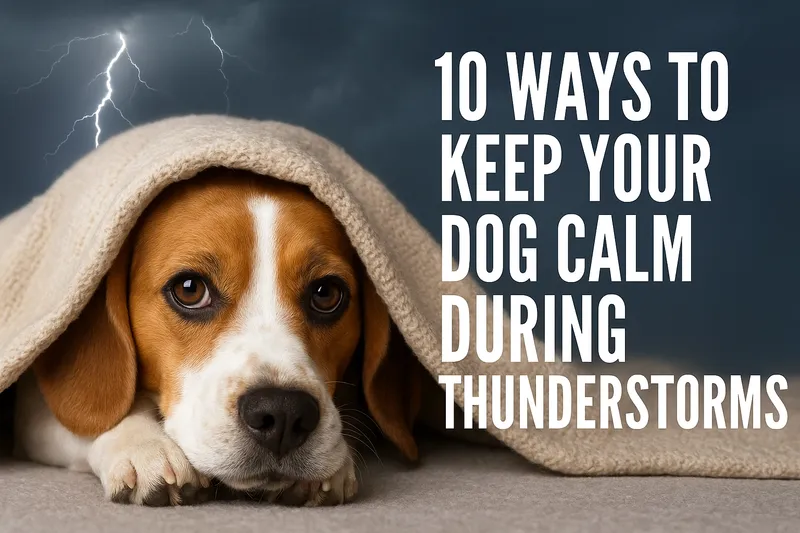
If your dog hides under the bed, paces in circles, or shakes uncontrollably the moment a storm rolls in, you're not alone — and your dog isn't being dramatic. Thunderstorm anxiety affects up to 40% of dogs, and for many, it's not just the noise. Dogs can sense changes in barometric pressure, smell ozone in the air, and feel the static electricity that builds before a storm. By the time you hear the first rumble, your dog has known something was coming for hours.
The good news: thunderstorm anxiety is manageable. With the right combination of preparation, environment, and behavioral tools, you can dramatically reduce your dog's fear — sometimes even eliminate it.
Here are ten strategies that genuinely work.
1. Create a designated safe space — and prepare it before the storm
Dogs cope with fear by seeking shelter. Give them a place they trust before they need it.
A bathroom (windowless and quiet), a closet, or a crate covered with a blanket all work well. The goal is a small, enclosed space where outside sounds are muffled. Add a favorite blanket, a chew toy, and an article of your worn clothing — your scent is a powerful calming signal.
Introduce the space on calm days first. If your dog only sees it during storms, they'll associate it with the fear, not the safety. Practice cuddles and treats in the safe space when the weather is clear.
2. Mask the sound with white noise or familiar music
Sudden, sharp noises trigger the fear response. Continuous background sound covers the gaps between thunderclaps and prevents your dog from being startled by each new boom.
What works:
- A white noise machine or fan
- Soft instrumental music (classical and reggae have been shown in studies to reduce canine stress)
- The TV at a moderate volume
What to avoid: loud music with sharp drops or percussion. The goal is smoothness, not volume.
3. Try a pressure wrap (like a ThunderShirt)
Gentle, constant pressure has a calming effect on many anxious dogs — similar to how swaddling soothes infants. Brands like ThunderShirt, AnxietyVest, or even a snug t-shirt wrapped securely can deliver this effect.
Studies on pressure wraps show about 70% of dogs benefit from them, particularly when introduced before symptoms peak. Put the wrap on at the first sign of an incoming storm, not after your dog is already panicking.
A note: pressure wraps aren't magic. They reduce anxiety; they don't eliminate it. Pair them with other strategies for best results.
4. Stay calm yourself — your dog is watching
Dogs are remarkable at reading human emotion. If you tense up, speak in a strained voice, or rush around closing windows in a panic, your dog will absorb that energy and assume the threat is even bigger than they thought.
The opposite is also true. Calm, matter-of-fact behavior tells your dog that everything is fine.
This doesn't mean ignoring your dog. Sit with them, speak softly, breathe deeply. Your steady presence is one of the most powerful calming tools you have — no equipment required.
5. Don't punish fearful behavior
When a frightened dog whines, paces, or hides, the instinct for some owners is to scold or shoo them away. Don't.
Fear isn't disobedience. Punishing a fearful dog teaches them that storms bring both the scary noise AND your displeasure — making the next storm even worse. Instead, calmly acknowledge them, redirect to the safe space, and let them choose how to cope.
There's also no need to worry about "reinforcing" fear by comforting your dog. Older training wisdom claimed soothing would make anxiety worse — modern behavioral research has thoroughly debunked this. Comfort your dog. It helps.
6. Engage their brain with food puzzles or chews
A dog focused on extracting peanut butter from a Kong toy is a dog who isn't focused on the thunder. Mental engagement is one of the fastest ways to interrupt the fear response.
Good options:
- A frozen Kong filled with peanut butter or wet food
- A snuffle mat with treats hidden inside
- A long-lasting chew like a bully stick or yak cheese
- A puzzle feeder with kibble
Start the activity at the first sign of an approaching storm. Catching the anxiety early — before it peaks — is far more effective than trying to redirect a dog who is already past their threshold.
7. Use calming pheromones or supplements
Several over-the-counter options can take the edge off mild to moderate anxiety:
- Adaptil (DAP — Dog Appeasing Pheromone) plug-in diffusers and sprays release a synthetic version of the pheromone mother dogs produce, which has calming effects on dogs of all ages
- Composure chews from VetriScience use L-theanine and colostrum
- CBD treats designed specifically for dogs (verify dosing with your vet first)
These work best as part of a broader strategy, not as a standalone fix. They take the panic edge off — they don't replace environment and behavioral tools.
8. Drown out the static — let them touch ground
Some researchers believe that static electricity buildup contributes significantly to thunderstorm anxiety in dogs. The theory: as static builds in your dog's fur during a storm, they get small shocks when they touch metal objects, the floor, or you — which reinforces their association of storms with discomfort.
A simple intervention: rub your dog down with an anti-static dryer sheet (unscented), or have them lie on a rubber-backed mat or thick rug. Some owners report dramatic improvement from this alone.
It's a small thing. It might do a lot.
9. Stick to your routine
It's tempting to cancel walks, postpone meals, or hover anxiously when bad weather is forecast. Don't.
Routine is grounding. A dog whose morning walk happens at the same time, whose dinner appears in the same bowl, who gets the same calm evening — that dog has more emotional bandwidth to handle a storm when it arrives.
If the storm hits during walking time, an exception is fine. But broadly, treating storm days as "special anxiety days" can amplify the dog's sense that something is genuinely wrong.
10. For severe cases — talk to your vet
If your dog's thunderstorm anxiety is extreme — destructive behavior, self-injury, refusing to eat for hours, prolonged trembling — please don't try to solve it alone.
A veterinarian can:
- Rule out underlying medical conditions
- Prescribe situational anti-anxiety medication for the worst storms (like trazodone or alprazolam, taken before the storm hits)
- Refer you to a veterinary behaviorist for a longer-term desensitization plan
Behavioral medication is not a failure or a last resort. It's a tool — and for dogs with severe storm phobia, it can be life-changing. Don't let pride keep your dog suffering when help is available.
A final word
Thunderstorm anxiety in dogs is real, common, and treatable. Most dogs improve significantly with consistent, compassionate intervention — but improvement is a journey, not an overnight switch. Be patient with your dog and with yourself.
The most important thing you can give an anxious dog is your steady, calm presence. Everything else — the supplements, the wraps, the safe spaces — supports that one essential thing.
The storm will pass. With the right preparation, your dog will get through it too.