
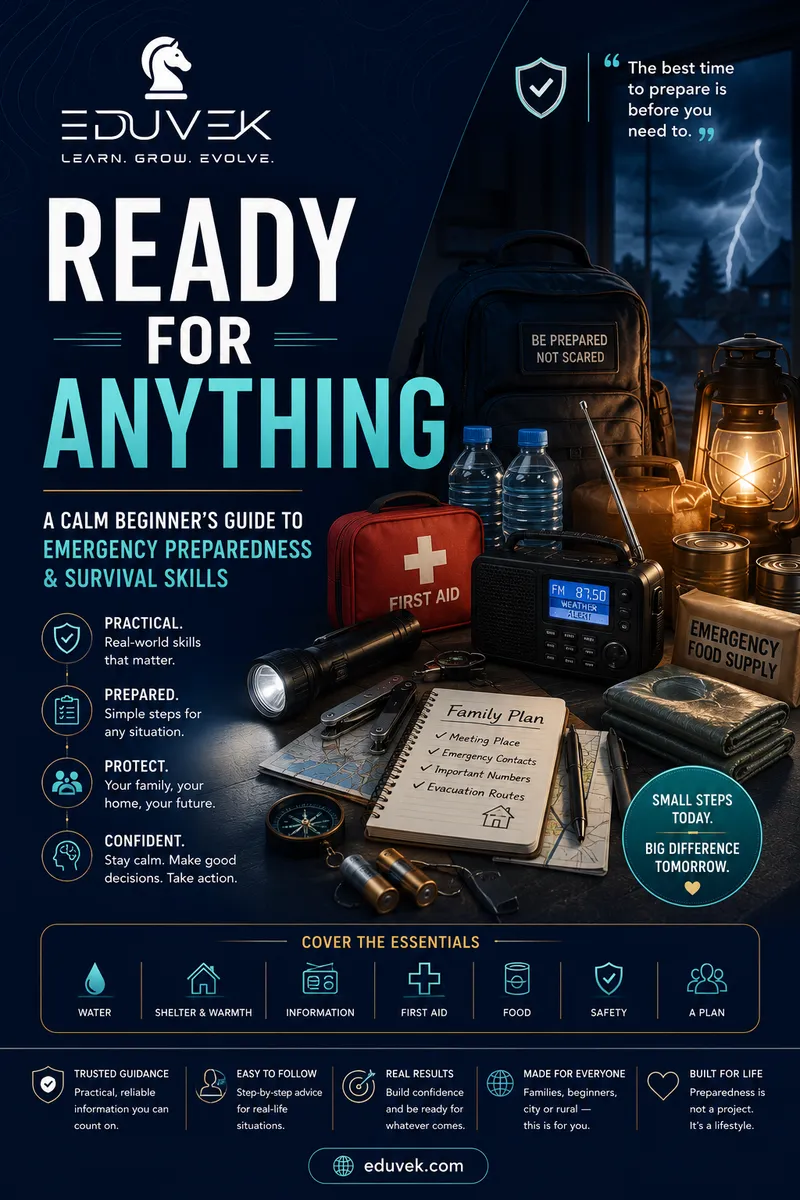
Preparedness isn't about fear, and it isn't about stockpiling for the end of the world. It's about giving your future self a little breathing room — so that when the power goes out, the water stops, or the road closes, you have a plan instead of panic.
Most emergencies are ordinary: a storm, an outage, a burst pipe, a few days stuck at home. The people who get through them calmly aren't the ones with a bunker. They're the ones who took an afternoon, once, to think it through. This guide is that afternoon.
Work through it at your own pace. You don't need everything at once — start with water and a plan, and build from there.
Start with water
Water is the first thing you'll miss and the hardest to improvise. Aim for one gallon (about four litres) per person per day, and store at least three days' worth — more if you can. A week is a comfortable target.
Commercial bottled water is simplest and stores for a long time. If you fill your own containers, use food-grade ones, label them with the date, and rotate every six months. Keep some water where you'd actually shelter, not just in the garage.
Know how to make water safe, too: a rolling boil for one minute kills most pathogens, and unscented household bleach (eight drops per gallon, stirred and left for 30 minutes) works when you can't boil. A basic water filter is a worthwhile backup.
Stay warm and dry
Cold is dangerous long before it's dramatic. If the heat fails in winter, your plan is layers, not a single big solution.
Keep wool blankets, a sleeping bag rated for your climate, warm hats, and dry socks together in one place. Close off a single small room and keep everyone in it — body heat in a small space goes a long way. Never run a generator, grill, or camp stove indoors; carbon monoxide is silent and deadly.
Dryness matters as much as warmth. Wet clothing pulls heat from the body fast, so keep a change of dry clothes in your kit and a few large contractor bags that can serve as improvised rain gear.
Make a family plan
The most useful thing in an emergency is a shared plan everyone already knows. Decide it now, on a calm day.
Agree on two things: where you'll meet if you're separated and can't get home, and one out-of-area contact everyone will text. Local lines jam first; a relative a few cities away can relay messages when you can't reach each other directly.
- A meeting point near home, and a second one farther away
- One out-of-area contact everyone memorizes or carries on paper
- Who picks up the kids, and who checks on an elderly neighbor
- Where the kit, water, and important documents live
- How you'll reach each other if the cell network is down
Build a little financial readiness
When card readers are down and ATMs are offline, cash is king. Keep a modest amount of small bills somewhere safe at home — enough for a few days of essentials.
Keep copies of the documents you'd hate to lose: ID, insurance, prescriptions, account numbers. A sealed envelope in your kit plus an encrypted copy in the cloud covers both 'I had to leave fast' and 'the house is gone.' A small emergency fund, even a few hundred dollars, turns many crises into inconveniences.
Stay calm under pressure
Your calm is a resource — for you and for everyone watching you, especially children. Fear narrows thinking; a few deliberate breaths widen it back out.
When something goes wrong, slow down before you act: stop, take three slow breaths, and name the single most important thing to do next. Then do only that. Preparation is what makes calm possible — when the basics are already handled, your mind is free to solve the actual problem instead of scrambling for water and a flashlight.
Know your community
Resilience is rarely solo. The household that checks on its neighbors — and is checked on in return — is far safer than the one that bunkers down alone.
Introduce yourself to the people nearby before you need them. Know who has medical training, who has tools, who lives alone, who might need help evacuating. Keep a paper list of local numbers: non-emergency police, your utility, a trusted neighbor. In most real emergencies, help arrives from two doors down long before it arrives from anywhere official.
Shelter safely in a crisis
Sometimes the safest move is to stay put; sometimes it's to leave. Knowing the difference ahead of time saves precious minutes.
Shelter in place when going outside is the greater risk — severe weather, an outage, an air-quality event. Pick an interior room, keep your kit and water there, and have a way to get official updates (a battery or hand-crank radio earns its place here). Evacuate when staying is the greater risk — fire, flood, or an official order. Keep a 'go bag' by the door and your vehicle at least half-full of fuel, and leave early rather than late. Whichever you choose, tell your out-of-area contact where you're going.
Preparedness is a habit, not a project. You don't finish it — you just keep it lightly topped up: rotate the water, refresh the batteries, revisit the plan once a year. Done a little at a time, it stops being a chore and becomes quiet confidence.
Download the full guide below to keep on hand, and share it with someone you'd want to be ready, too.