
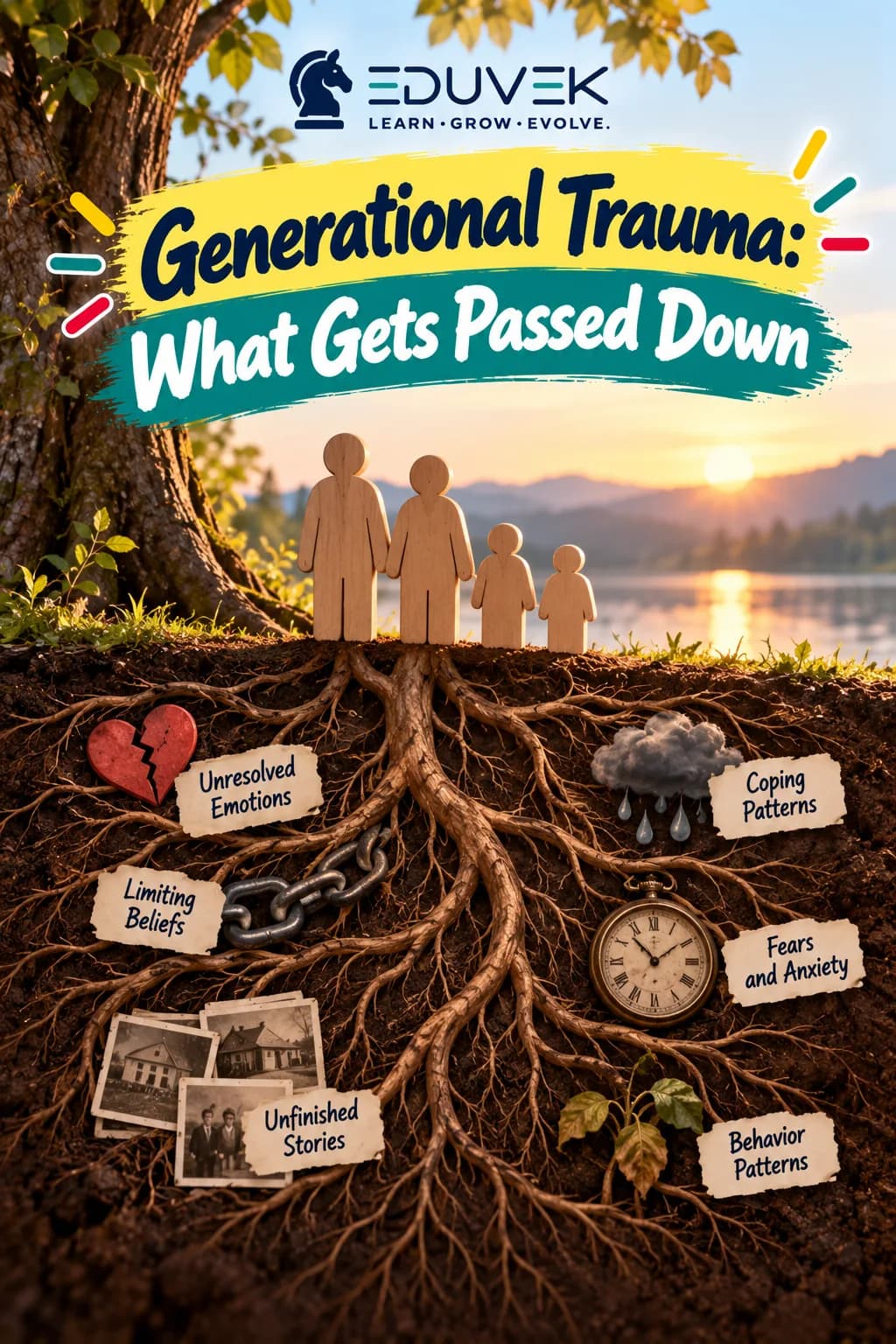
Generational trauma describes the observation that the effects of a difficult event can appear in people who didn't experience it — the grandchildren of refugees, the children of someone who grew up in violence or poverty. It's a widely used term, and it's worth being precise about what's actually understood and what isn't.
What's well documented
Behaviour transmits. A parent shaped by scarcity raises children around scarcity, whether or not there's money. Someone who learned that the world is unsafe teaches vigilance without ever saying so. Children absorb how the adults around them respond to stress, and then respond that way themselves.
Silence transmits too. Families often don't talk about the worst thing that happened to them, and children register the shape of the gap — that there's a subject, that it's not discussed, that asking produces discomfort.
And circumstances transmit. Displacement, lost education, lost property and lost standing all affect what the next generation inherits in practical terms, quite apart from anything psychological.
What's less settled
There's research into whether severe stress produces biological changes that can be inherited — the field of epigenetics. It's genuinely interesting and genuinely unresolved, and the popular version runs far ahead of what the evidence supports.
Be sceptical of anything claiming your grandmother's experience is written into your cells in a specific, identifiable way. The behavioural and social explanations account for most of what people notice, and they're substantial enough without the speculative part.
Why it matters that this is named
People often arrive at this subject because something doesn't add up — a fear with no event behind it, a reaction out of proportion to what triggered it, a family mood that was always present and never explained.
Discovering there's a history behind it is often a relief, because the alternative explanation was that something was wrong with them personally.
What people do with it
Learning the actual history, which frequently means asking questions no one has asked. Noticing which responses are inherited rather than chosen. And, where possible, deciding not to pass on the silence, even if everything else continues.
A note on help
If what you're carrying is heavy — if it affects your sleep, your relationships or your capacity to function — that belongs with a licensed therapist or a doctor. Reflective practices can be a useful part of understanding a family's history. They are not treatment for trauma, and nobody should offer them as such.