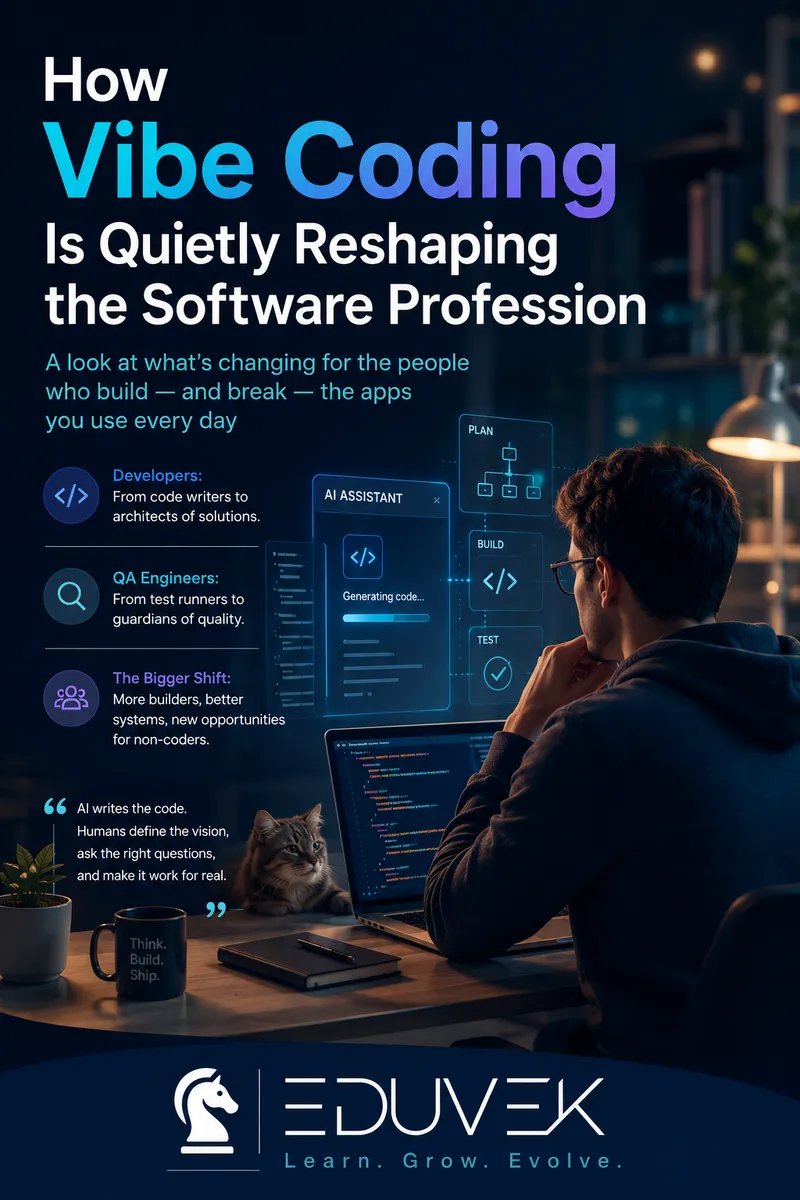
A look at what's changing for the people who build — and break — the apps you use every day.
For decades, building software looked like a closed world.
To enter it, you needed years of study, a deep understanding of programming languages, endless debugging sessions, and the patience to memorize systems that often seemed designed to confuse beginners. Whether someone earned a computer science degree or taught themselves over years of trial and error, the path was long.
The people who mastered it became developers. The people who tested their work became QA engineers. Together, they built the digital world.
That world is changing.
Not because software suddenly became simple — it hasn't — but because artificial intelligence fundamentally changed what “building software” actually means.
The shift is already underway, and it has a name: vibe coding. Quietly, almost invisibly, it is reshaping two of the most important professions in technology.
What Is Vibe Coding?
Vibe coding is the practice of directing AI systems to help create software. Instead of manually typing every line of code, builders describe what they want in plain language:
- “Create a login system.”
- “Build a dashboard with analytics.”
- “Make this mobile-friendly.”
The AI writes the code. The human reviews it, adjusts it, tests it, improves it, and decides whether it actually solves the problem.
The name “vibe coding” sounds playful, but the shift behind it is serious. For the first time in software history, a person with strong ideas, problem-solving ability, and clear communication skills can build applications without mastering every technical detail traditionally required.
A single individual can now create products that once required entire teams. Not prototypes. Not mockups. Real software — web apps, internal business tools, platforms, automations, products people actually use.
Before AI: developers were both architects and bricklayers
Historically, software developers performed two completely different kinds of work at the same time. They were:
- Architects — designing systems, planning data flow, choosing technologies, solving structural problems.
- Bricklayers — manually writing every line of code, syntax, configuration, and repetitive setup.
These are not the same skill. Architecture requires judgment. Typing code requires precision and repetition. The best developers could do both, but much of a developer's day was consumed by mechanical work:
- Writing boilerplate code
- Remembering syntax
- Formatting configurations
- Connecting repetitive components
- Searching documentation for tiny implementation details
That repetitive labor created a barrier to entry. It also consumed enormous amounts of time.
AI has automated much of the mechanical work
Modern AI coding tools — Claude Code, Cursor, GitHub Copilot, Windsurf, and others — now generate large amounts of code almost instantly. They remember syntax. They scaffold applications. They connect APIs. They write repetitive structures.
What once took hours can now take minutes.
This does not eliminate developers. It changes what developers spend their energy doing.
The highest-value skill is no longer “typing fast” or “memorizing frameworks.” The valuable skills now are:
- Making good architectural decisions
- Knowing which AI-generated solutions are flawed
- Understanding tradeoffs
- Asking better questions
- Reviewing systems critically
- Thinking clearly under uncertainty
Software work is becoming less about execution and more about judgment.
That is a massive professional shift.
The most important skill is becoming taste
One of the strangest consequences of AI-assisted development is that technical skill alone is no longer enough. AI can generate code. It cannot reliably generate good judgment.
Two people can give the same prompt and receive completely different outcomes based on what they ask for, what they notice, what they refine, and what they reject.
This means software creation increasingly resembles creative direction. The best builders are becoming editors, strategists, and systems thinkers. They know when something looks correct but is structurally fragile. They know when the AI solved the wrong problem elegantly.
And importantly: they know when to slow down. Because AI accelerates production, but speed often hides mistakes.
Junior developers are entering a different industry
One of the biggest unanswered questions is what happens to the traditional learning ladder. Historically, junior developers learned through repetition — fixing small bugs, writing basic features, maintaining legacy code, handling repetitive tasks.
Those repetitive tasks are increasingly automated. Which creates a difficult question: if AI performs most beginner-level coding work, where do beginners gain experience?
The industry does not yet have a clear answer. Some companies are already reducing entry-level hiring. Others are redefining junior roles entirely. The apprenticeship model that built generations of engineers is beginning to wobble.
At the same time, developers who adapt quickly are becoming dramatically more productive than before. A skilled engineer working with AI can now accomplish what previously required several people.
The result is a profession simultaneously experiencing increased productivity, lower technical barriers, higher expectations, and greater uncertainty — all at once.
QA engineering is being reshaped too — but differently
If developers are losing some mechanical work, QA engineers are gaining importance. Why?
Because AI-generated code introduces problems at incredible speed. When humans write software slowly, they naturally pause to think. When AI generates hundreds or thousands of lines instantly, hidden assumptions multiply faster than any single person can fully review in real time.
This creates an environment where careful testing becomes more valuable, not less.
Good QA engineers think differently from developers. They ask questions like:
- What happens if the network fails halfway through?
- What if a user enters unexpected input?
- What if two systems disagree?
- What happens under stress?
- What breaks when real people behave unpredictably?
AI is optimized for the “happy path.” QA is optimized for reality.
Modern QA is becoming systems thinking
The stereotype of QA as “people running checklists” is increasingly outdated. Modern QA work involves:
- Systems analysis
- User behavior modeling
- Risk prediction
- Cross-platform testing
- Communication between technical and non-technical teams
- Investigating subtle failures
In many ways, QA engineers are becoming operational philosophers of software. They study how systems fail, why humans misunderstand interfaces, where assumptions collapse, and how edge cases emerge.
And increasingly, they must understand AI-generated systems that even developers themselves may not fully comprehend.
The rise of the technical non-coder
One of the most underestimated changes happening right now is the emergence of a new category of builder: the technical non-coder.
These are people who think clearly, understand workflows, know a business domain deeply, communicate effectively, and can direct AI systems intelligently — but may never become traditional programmers.
Teachers. Designers. Project managers. Healthcare workers. Lawyers. Operations specialists. Small business owners.
These people can now create internal tools, websites, automations, dashboards, and platforms that directly solve their own problems. Often, their products are surprisingly effective because they understand the real-world problem better than a purely technical outsider would.
That is one of the deepest changes AI introduces: software creation is expanding beyond the software profession itself.
The new bottleneck is no longer coding
For years, coding itself was the bottleneck. Now the bottlenecks are shifting toward:
- Clear thinking
- Product judgment
- Communication
- UX understanding
- Testing
- Reliability
- Strategic decision-making
Bad software is easier to create than ever before. Which means good software becomes even more valuable.
AI lowers the cost of production. It does not automatically improve quality. If anything, quality becomes harder to maintain because production speed increases so dramatically. This is why experienced professionals still matter enormously.
The hidden risk: overconfidence
AI-generated code often looks convincing. That creates a dangerous illusion. A beginner may believe: “The AI wrote it, therefore it must be correct.”
But software failures are rarely obvious. Applications can work correctly for weeks before failing, expose security vulnerabilities, leak user data, collapse under scale, or produce inaccurate results silently.
This is where human skepticism becomes essential. The future belongs less to people who trust AI blindly — and more to people who can collaborate with it critically.
What AI still cannot replace
Despite rapid progress, several deeply human abilities remain difficult to automate.
Judgment — knowing which solution matters.
Context — understanding why a business or user behaves a certain way.
Taste — recognizing whether something feels intuitive, clean, elegant, or trustworthy.
Prioritization — choosing what matters under limited time and resources.
Responsibility — owning the consequences when software affects real people.
AI can generate possibilities. Humans still decide which possibilities deserve to exist.
So what does this mean for everyone else?
If you're watching this shift from outside the tech industry, here's the honest summary.
The barrier to entry is lower than ever. You no longer need a four-year degree to begin building software.
The barrier to mastery remains high. Creating software that is secure, scalable, reliable, and genuinely useful still requires serious thinking.
The profession is evolving, not disappearing. Developers and QA engineers are not becoming obsolete. Their roles are becoming more strategic, conceptual, and judgment-driven.
Clear communication is becoming a technical skill. The ability to explain ideas precisely may become as valuable as coding itself.
Domain expertise matters more now. People who deeply understand real-world industries suddenly have the power to build solutions directly.
A final thought
It's tempting to frame AI as “replacing programmers.” That description misses the deeper truth.
AI is replacing certain forms of repetitive execution. Humans are being pushed toward higher-level work — better judgment, better systems thinking, better communication, better decision-making, better problem definition.
The developer's typing speed matters less. The QA engineer's skepticism matters more.
And perhaps most importantly: a thoughtful person who never considered themselves “technical” can now participate in building software. Not effortlessly. Not magically. But realistically.
That used to be nearly impossible. Now it's simply difficult.
And that may be one of the most important professional shifts of the next decade.