
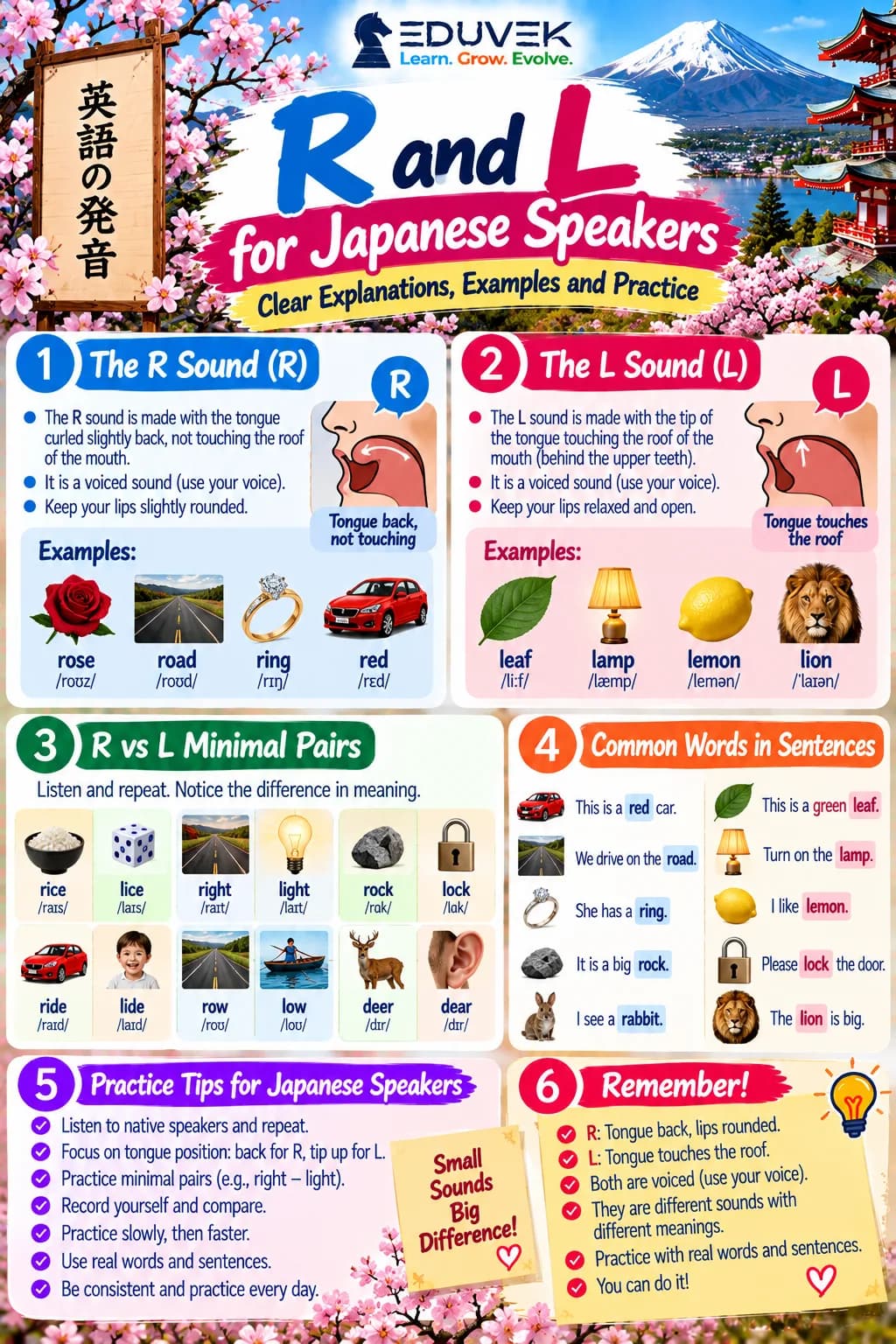
The English R and L trip up almost every Japanese learner, and it isn't a matter of effort or talent. Japanese has a single sound — the ら row — that sits between the two English sounds, so your ear and mouth were never trained to tell them apart.
The good news: this is a physical skill, like a tennis swing, not a talent you either have or don't. Once you know what each sound asks your tongue to do, you can train them deliberately.
Why it's genuinely hard
The Japanese "r" in ra-ri-ru-re-ro is a quick tap — the tongue flicks the ridge behind your teeth and leaves instantly. Neither English R nor English L is that tap. Because one Japanese sound covers territory English splits in two, your brain learned to hear right and light as the same thing — and you can't easily produce a difference you don't yet hear. So this is two skills at once: hearing the pair, and making the pair.
What L actually does
For L, the tip of your tongue touches the ridge just behind your top teeth and stays there while the sound flows around the sides. Say light, really, hello, call slowly and notice the tongue pressing and holding. A useful check: with an L, the tongue is anchored; it doesn't float. Hold it a beat longer than feels natural at first — exaggeration is how the muscle memory forms.
What R actually does
For R, the opposite: the tongue pulls back and touches nothing, while your lips round slightly, as if you were about to say "w." Try right, road, around, car. The tongue bunches or curls back in the middle of your mouth and floats — no contact, no tap. If your tongue touches anything, you've drifted toward L or toward the Japanese tap. "Floating and rounded" is the whole trick.
Train your ear, not just your mouth
Because the sounds blur together in perception, spend time listening before you worry about speaking. Use minimal pairs — words identical except for R/L — and listen until the difference is obvious: right/light, rice/lice, correct/collect, pray/play, fry/fly. Apps and dictionaries with audio help; so does watching a speaker's mouth. When you can reliably hear which is which, producing it gets dramatically easier.
Drills that actually move the needle
Say minimal pairs out loud, slowly, exaggerating the tongue position — anchored for L, floating for R. Record yourself on your phone and compare to a native clip; your ears catch what your mouth misses. Practise R and L inside real words and short sentences, not just in isolation, because the hard part is switching between them mid-word (really, world, girl, railroad). Five focused minutes a day beats one long session.
Aim for clear, not flawless
A slight accent is completely fine and never disappears entirely for most adult learners — that's normal and not a problem. Clarity is the goal: listeners rely on context too, so one clean R or L in a sentence carries a lot. Don't let the fear of a perfect R keep you from speaking; the sound improves by speaking, not by waiting.