
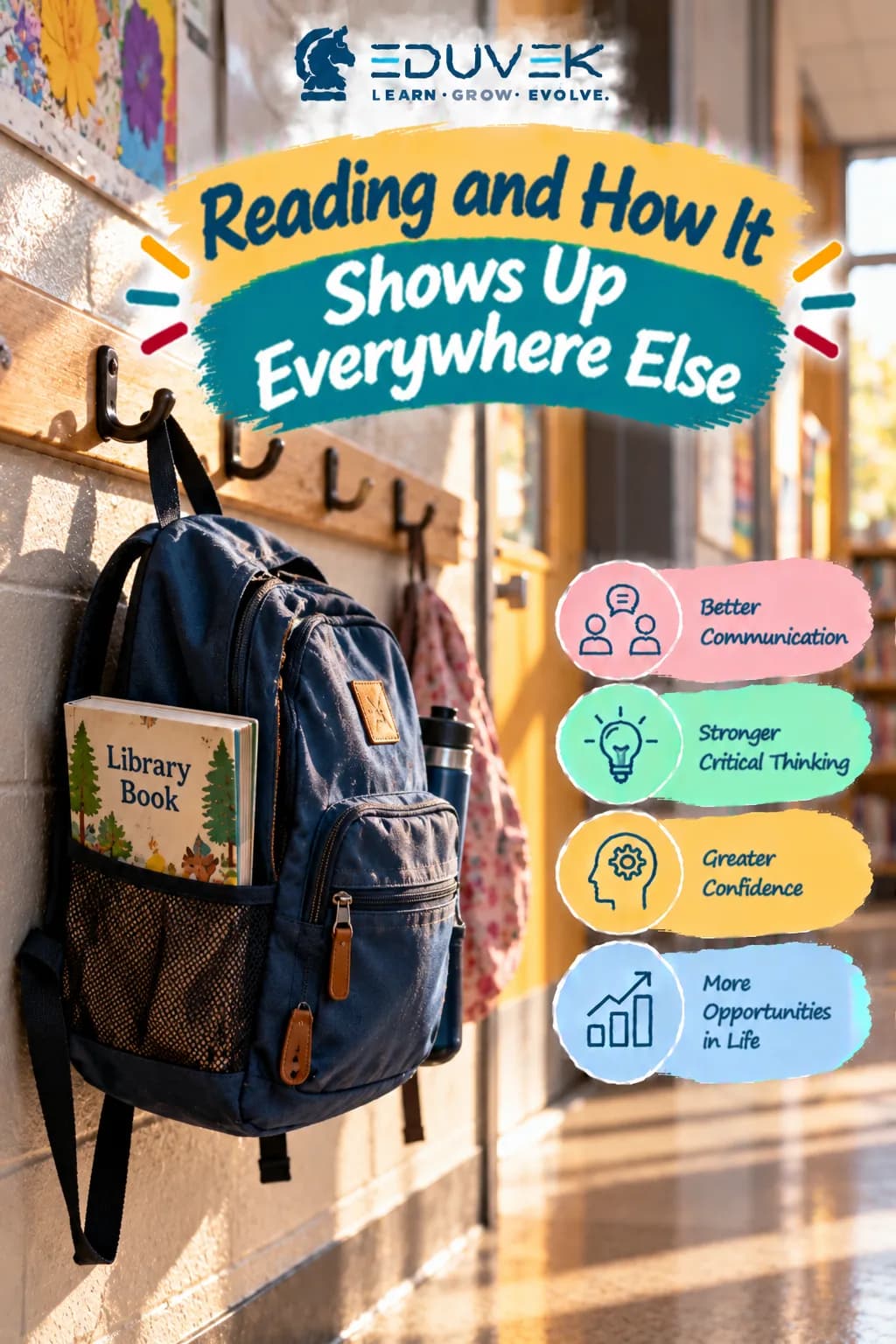
Reading is the subject that turns out to be all the other subjects. A child who reads well does better in science, history, maths word problems and anything with an exam, and the reason is more mechanical than inspirational.
Vocabulary is the engine
The clearest part of the picture.
Most of the words a child knows by adolescence were not taught — they were met in reading. Spoken language, including adult conversation, uses a relatively narrow set of common words. Books use a much wider range, and they're where uncommon words are encountered.
Vocabulary then determines comprehension, and comprehension determines performance in every subject taught through text. A child who doesn't know the words in a science question can't answer it, however well they understand the science.
The gap widens on its own
The uncomfortable mechanism.
A child who reads fluently reads more, because it isn't effortful. Reading more builds vocabulary and background knowledge, which makes further reading easier still.
A child who reads with difficulty reads less, meets fewer words, and finds each subsequent year's material harder relative to their peers.
Neither child is working harder than the other. The gap compounds because of volume, which is the strongest argument for intervening early and for prioritising quantity over quality.
Background knowledge
Less discussed and nearly as important.
Comprehension depends heavily on already knowing something about the subject. A reader who knows roughly what a volcano is will understand a passage about one far better than a reader with identical decoding skills and no prior exposure.
Wide reading — fiction included, and non-fiction about whatever a child is obsessed with — builds a general stock of knowledge that makes future texts comprehensible. That's a large part of why reading about dinosaurs for two years is not a waste of time.
What this doesn't mean
Two honest qualifications.
Correlation isn't all causation. Children who read a lot differ from children who don't in many ways — home environment, access to books, time, adult attention. The reading is doing real work and it isn't doing all of it.
Reading isn't a programme to be administered. The benefit comes from volume sustained over years, and volume comes from children choosing to read. Required reading produces much less of it. The route to the academic outcome runs through enjoyment, which is inconvenient for anyone hoping to shortcut it.
What actually moves the needle
Volume, not level. More books, including easy ones. Fluency comes from quantity.
Their choice of material. Choice is what produces volume, and the two cannot be separated.
Reading aloud, continuing past the independent stage. It builds vocabulary and comprehension above the child's own decoding level, which is exactly where the academic benefit sits.
Not measuring it. Counts and levels tend to reduce voluntary reading, and voluntary reading is where the effect comes from.
The short version
Reading isn't one subject among many. It's the mechanism through which the others are learned, and the most useful thing a parent can do about school performance is often not about school at all.