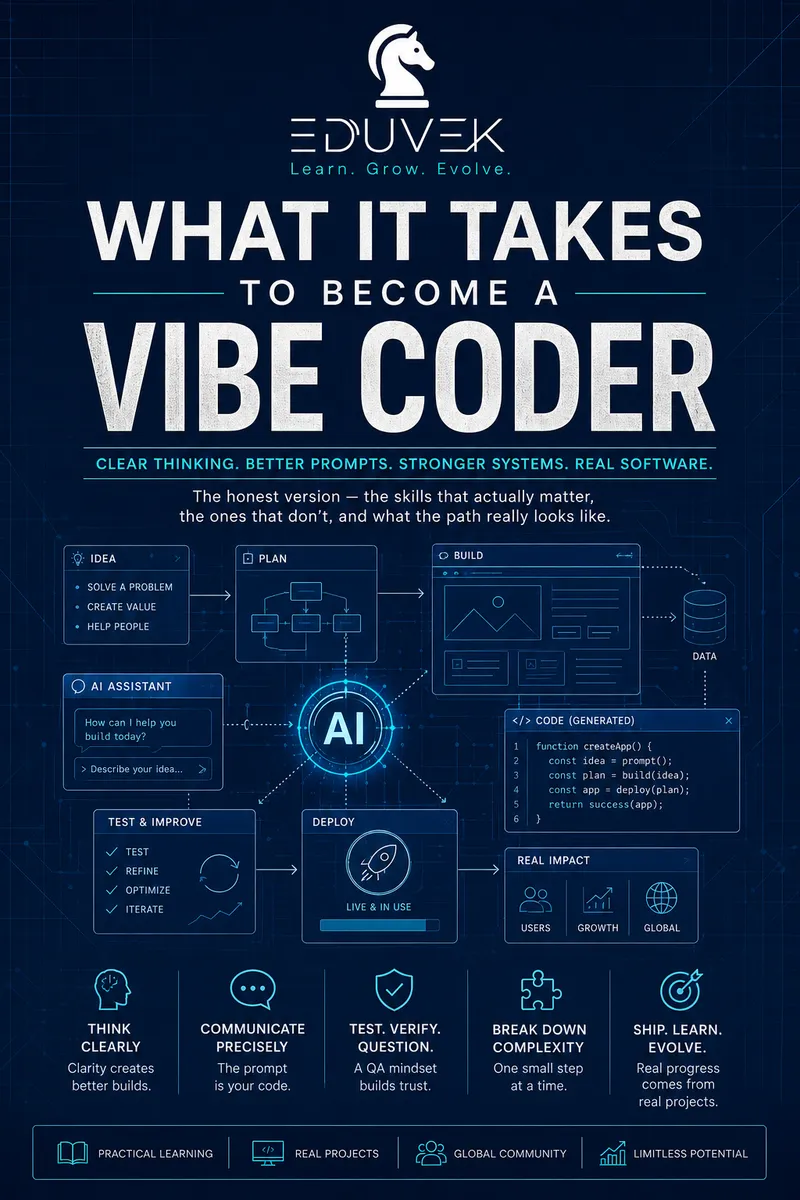
The honest version — the skills that actually matter, the ones that don't, and what the path really looks like.
A few years ago, the answer to "what does it take to build software?" was simple and intimidating: years of study, a programming language or three, and the patience to memorize systems that often seemed designed to confuse beginners.
That answer is changing.
Vibe coding — directing AI systems to help build software, instead of typing every line by hand — has lowered the entry barrier dramatically. A thoughtful person who never considered themselves "technical" can now build real applications: web apps, business tools, automations, products people actually use.
But "lower barrier" is not the same as "no barrier." Vibe coding doesn't remove the work — it moves it. The hard part is no longer memorizing syntax. The hard part is judgment, clarity, and care. And those are skills you can build.
So what does it actually take? Here's the honest breakdown.
First, what you DON'T need
Let's clear away the myths, because they stop people before they start.
You don't need a computer science degree. You don't need to memorize programming languages. You don't need years of training before you can build anything useful. You don't need to be a "math person," and you don't need to already understand how software works under the hood.
The AI handles the mechanical layer — the syntax, the boilerplate, the repetitive setup that used to be the price of entry. That part is genuinely no longer your job.
What you do need is a different set of skills entirely — and most of them have nothing to do with code.
Clear thinking
This is the foundation. Vibe coding is the practice of describing what you want clearly enough that an AI can build it. If your thinking is fuzzy, the result will be fuzzy.
The best vibe coders can take a vague idea — "I want a booking system" — and break it into precise, ordered pieces: what the user sees first, what happens when they click, where the information goes, what could go wrong. The clearer the thinking, the better the build.
Clear communication
Closely tied to clear thinking, but its own skill. In vibe coding, the prompt is the work. You're not typing code; you're explaining intent. The ability to describe exactly what you mean — specifically, in the right order, with the right detail — is now a technical skill in its own right.
People who communicate precisely get dramatically better results than people who communicate vaguely, even with the identical tool.
A QA mindset — testing and skepticism
Here is one of the most underrated skills, and arguably the most important: the instinct to test, verify, and distrust "it looks fine."
AI-generated code is fast and convincing — which is exactly what makes it dangerous. It often looks correct while being subtly broken. Software can run perfectly for weeks before failing, leaking data, or collapsing under real use.
A good vibe coder thinks like a QA engineer:
- What happens if the user enters something unexpected?
- What if the network fails halfway through?
- What breaks when real people behave unpredictably?
- Does this actually work, or does it just look like it works?
AI is optimized for the "happy path." Reality isn't. The person who tests carefully — who tries to break their own work before a user does — builds things that actually hold up. This skepticism is not negativity; it's craftsmanship.
Attention to detail
Software is unforgiving about small things. A single wrong setting, a mismatched name, a value in the wrong place — and something quietly stops working.
The people who do well at vibe coding are the ones who notice. They catch the detail that's slightly off. They spot the regression that wasn't there yesterday. They read carefully instead of skimming. In a world where AI produces a lot of output fast, the ability to notice what's wrong in that output is enormously valuable.
Following instructions — and giving them precisely
Vibe coding is a two-way street of instructions. You follow steps (setup, configuration, deployment) that must be done exactly and in order — skipping or reordering them breaks things. And you give instructions to the AI that must be just as precise.
Being methodical — doing things step by step, in sequence, without cutting corners — is a real advantage. The casual "I'll just wing it" approach tends to produce broken results and confusing messes.
Judgment, or "taste"
When AI can generate ten different solutions to the same prompt, the scarce skill becomes choosing the right one. This is what experienced builders call taste: recognizing whether something is clean, sensible, and trustworthy — or whether it merely looks correct while being fragile underneath.
Taste is knowing when the AI solved the wrong problem elegantly. It's knowing when to accept an answer and when to push back. It develops with practice and attention, and it's what separates someone who produces output from someone who produces good output.
Problem decomposition
Big goals are overwhelming. "Build a marketplace" is not a task an AI (or a person) can do in one step. The skill is breaking it down: into features, then into pieces, then into one clear instruction at a time.
People who can take something large and ambiguous and turn it into a sequence of small, concrete steps thrive at vibe coding. It's a thinking skill, not a coding skill.
Persistence and patience
Building software — even with AI — involves things not working. Errors appear. Something breaks. The AI misunderstands. The first attempt is rarely the final one.
The people who succeed are not the ones who never hit problems; they're the ones who don't quit when they do. They debug calmly, try again, look things up, and keep going. Frustration tolerance is a genuine, learnable skill — and it matters more than raw talent.
Organization
A real project has many moving parts. The builders who keep things coherent — who maintain a clear structure, write down decisions, and keep their project tidy — move faster and break less than those who work chaotically.
Vibe coding rewards the organized mind: knowing where things are, what's been done, and what comes next.
Domain knowledge — knowing the real problem
This is the quiet advantage of the non-traditional builder. A teacher building a tool for their classroom, a small business owner automating their workflow, a nurse solving a problem they see every day — they understand the real problem better than a purely technical outsider would.
When you deeply understand the thing you're building for, you make better decisions about what to build. Domain expertise, combined with the ability to direct AI, is a powerful pairing — and it's one many newcomers already have without realizing it.
Curiosity and a willingness to not know
Comfort with not knowing everything. Vibe coding involves constantly encountering unfamiliar terms and ideas. The people who do well aren't the ones who already know — they're the ones who stay curious, ask questions, and look things up without feeling defeated by the gaps.
You don't need to understand everything before you start. You need to be willing to learn as you go.
What most beginners underestimate
Many people assume the AI will do all the thinking for them. The opposite is true. The better your thinking becomes, the better the AI performs. Vibe coding rewards clarity, planning, and decision-making far more than technical memorization — the quality of what you build rises and falls with the quality of how you think about it.
Security still matters
AI can generate working software quickly, but "functional" does not automatically mean "secure." A thing that runs is not the same as a thing that's safe. Understanding the basics — how logins and authentication work, how to protect user privacy, why backups and permissions matter, how data should be handled — remains genuinely important. AI will happily build something that works and quietly leaves a door unlocked. Knowing enough to ask "is this safe?" is part of the craft.
The importance of shipping
The fastest way to improve is to launch real projects. Not tutorials, not endless practice — real things, finished and put into the world. Every completed project teaches lessons that no lesson can: what breaks in reality, what users actually do, what you forgot to consider. Shipping is where the learning compounds.
A portfolio, not just a resume
In this new landscape, showing often matters more than telling. A collection of real work — websites, dashboards, automations, web apps — demonstrates capability more convincingly than credentials alone. The builder who can point to things they've actually made has an advantage over the one who can only describe what they've studied. Build things, and let the things speak.
The future of the builder
The future belongs to people who combine several strengths at once: deep knowledge of a real-world domain, clear communication, an understanding of how things work in practice, and the ability to direct AI effectively. The most successful builders of the next decade may not come from traditional computer science backgrounds at all. They may come from education, healthcare, consulting, law, small business, and countless other fields — people who understand a real problem deeply and can now, finally, build the solution themselves.
So — can you actually do this?
Here's the honest summary.
The barrier to entry is genuinely lower than ever. You don't need a degree or years of training to begin building real things.
The barrier to quality remains real. Building software that's reliable, secure, and genuinely useful still takes clear thinking, careful testing, judgment, and persistence.
But notice something about that list of skills: clear thinking, communication, attention to detail, testing instinct, following process, judgment, organization, domain knowledge, persistence, curiosity. Almost none of them are about code. They're about how you think and work. Many thoughtful people already have several of them — from completely unrelated fields.
That's the real shift. Becoming a vibe coder isn't about transforming into a traditional programmer. It's about bringing the thinking skills you may already have, pairing them with AI, and learning a workflow.
It used to be nearly impossible for a non-coder to build real software. Now it's simply difficult. And difficult things can be learned — with the right guidance, in the right order.
Eduvek's Vibe Coding courses are built exactly for this path — for thoughtful people who want to learn to build real software with AI, step by step, without a computer science background. From the fundamentals for complete beginners to deeper workflows for those ready to ship.