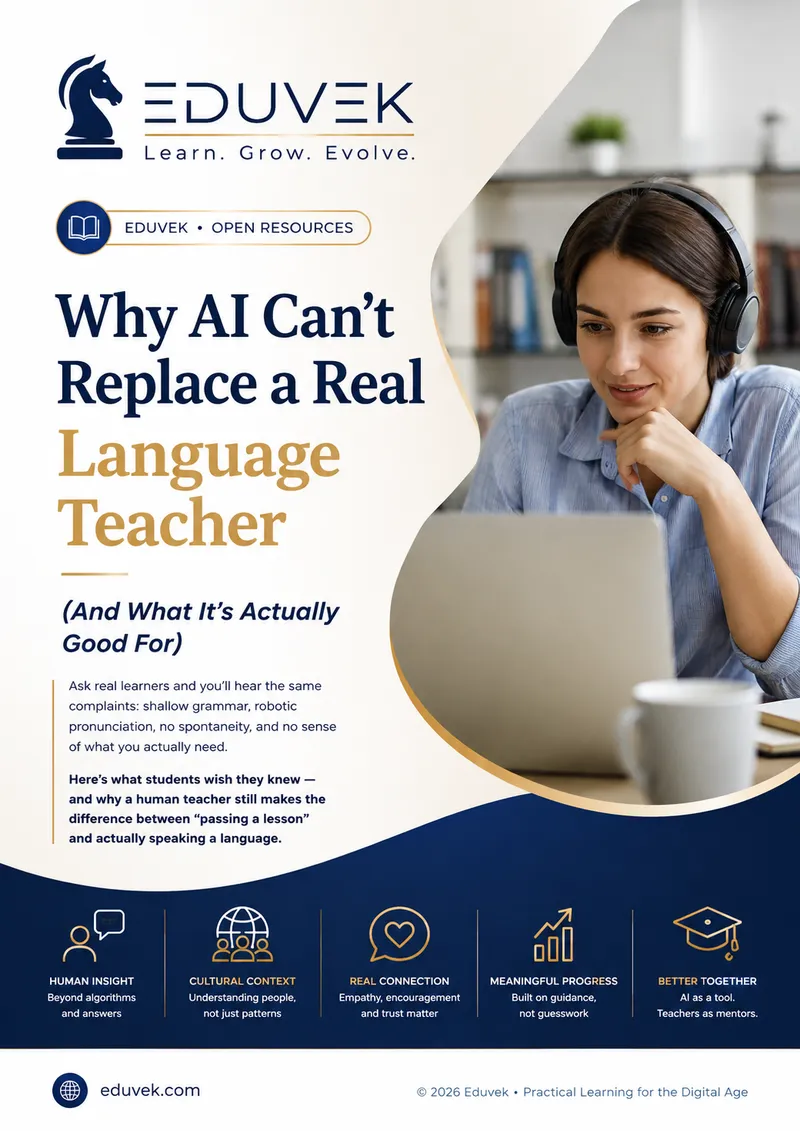
Ask real learners and you'll hear the same complaints: shallow grammar, robotic pronunciation, no spontaneity, and no sense of what you actually need. Here's what students wish they knew — and why a human teacher still makes the difference between "passing a lesson" and actually speaking a language.
Artificial intelligence has changed how people learn languages. Today's AI-powered apps offer instant grammar correction, personalized vocabulary drills, pronunciation feedback, and 24/7 availability. The appeal is obvious: an always-on learning companion that never gets tired, never loses patience, and adapts to your pace at two in the morning.
These tools are genuinely remarkable. They've made language practice more accessible than at any point in history.
And yet, despite everything they can do, AI systems are not language teachers in the true sense of the word.
Learning a language is not simply the acquisition of vocabulary and grammar. It is a deeply human process built on culture, emotion, identity, confidence, and connection. AI can be an exceptional learning tool — but it remains fundamentally limited as a teacher. Understanding that difference is the key to actually becoming fluent, rather than just completing lessons.
What Students Actually Say
Talk to people who have spent real time trying to learn a language with an app, and the same frustrations come up again and again. These aren't abstract objections — they're the lived experience of learners who gave AI an honest try:
- "It never really taught me grammar." AI is quick to check a sentence, but slow to teach the rule behind it. Learners report shallow, one-line explanations, no proper drilling, and a tool that happily moves on before anything has actually stuck. You end up knowing that something was wrong without ever understanding why.
- "The pronunciation is off — and it can't fix mine." Synthetic voices get word stress, rhythm, and regional sounds wrong, so learners absorb an unnatural accent. Worse, the app can't truly hear the subtle ways your pronunciation misses — the things a human ear catches instantly and corrects on the spot.
- "It has no feel for what I actually need." AI follows a script. It doesn't notice that you're bored, lost, or ready to be pushed harder. It can't sense the moment you're about to quit, or the moment you're about to break through.
- "It's not spontaneous." Real people go off-topic, crack jokes, misunderstand you in interesting ways, and drag you into conversations you weren't prepared for. That unpredictability is where real learning happens — and it's exactly what a scripted model can't reproduce.
- "There's no human on the other side." No encouragement that feels earned, no shared laugh over a mistake, no relationship to show up for. For a lot of learners, that missing human stake is the reason motivation quietly fades.
Every one of these complaints points to the same underlying truth: AI can test you, but it struggles to teach you — and it can't be with you. The rest of this article unpacks why.
Language Is Human Before It Is Technical
Language did not evolve as a system for transferring structured data. It evolved so human beings could build relationships, negotiate social situations, express emotion, share stories, and belong to a community.
When you learn a new language, you are doing far more than memorizing words. You are learning to express your identity in an unfamiliar voice. You are building the confidence to step into conversations, cultures, and rooms where you can't yet say everything you mean.
Experienced teachers understand this instinctively. They hear the uncertainty in your tone, notice the hesitation before you speak, and read the frustration behind a small mistake. They adjust their approach based not only on what you know, but on how you feel in the moment.
AI can analyze language patterns with astonishing precision. What it cannot do is understand the human experience behind them. It does not truly "understand" your sentence — it predicts the most statistically probable next word in a sequence. That distinction matters far more than most learners realize.
The Illusion of Fluency: Grammar Is Only the Foundation
Here's the irony: learners often complain that AI underteaches grammar — and they're right. An app is fast to flag that a sentence is wrong, but it rarely teaches the rule properly, drills it until it's automatic, or checks that you've truly understood before racing ahead. You're left correcting symptoms without ever learning the system underneath.
And even perfect grammar isn't the finish line. Grammar is just the floor. The harder, more important terrain is pragmatics — the unwritten rules that govern how language is actually used in real social, cultural, and situational contexts.
A sentence can be perfectly correct and still land as awkward, cold, or even rude in the wrong setting. Real teachers help you navigate the questions that grammar rules can't answer:
- How formal should I sound right now?
- How would a native speaker actually phrase this?
- Is this expression friendly, neutral, sarcastic, or offensive?
- What cultural assumptions are hidden inside these words?
Consider a simple line like "Could you open the door?" An AI reads it as a question about physical ability. A human teacher explains the implied request, the tone it carries, and how it shifts depending on whether you're speaking to a friend, a manager, or an elder.
Idioms, regional slang, humor, and social taboos vary wildly between dialects — and AI trained on generic web text tends to default to phrasing that sounds hyper-formal, sterile, or subtly "off" to native ears. Human educators don't just teach you what to say. They teach you when, why, and to whom — the cultural intuition that gives words their real meaning.
The Confidence Gap
Every language learner runs into the same uncomfortable moment: an adult who is articulate and capable in their native language suddenly struggling to order a coffee, mangling basic tenses, and expressing a fraction of what they actually think.
It's humbling. For many people, it's the exact point where they quietly give up.
Great teaching lives right here. A skilled teacher knows when to correct a mistake on the spot to stop a bad habit from setting in — and when to let an error slide so they don't crush a fragile moment of confidence just as a breakthrough is happening. That judgment is the heart of good pedagogy.
AI tends to fall into one of two traps:
- Hyper-correction — flagging every tiny error in real time, which spikes anxiety and kills the natural flow of speech.
- Hyper-validation — accepting broken or nonsensical input without meaningful correction, quietly building a false sense of competence.
Because AI has no emotional reality, it cannot read the psychological temperature of a lesson, and it cannot build genuine trust. Without trust, learners won't take the creative risks that fluency actually requires.
Practice Is Not the Same as Conversation
Modern AI can simulate conversation impressively well — instant responses, realistic dialogue, the feeling of a real exchange.
But a simulation of conversation is not conversation.
Real dialogue carries unpredictability, shared context, mutual accountability, and genuine curiosity about another person. When you talk to a human being, something is at stake: you want to be understood, you care about the relationship, you care how the exchange lands. Those social stakes are a major driver of how language gets encoded into long-term memory.
When you talk to an app, you know, on some level, that you're talking to a program. There's no real curiosity on the other side, no perspective to discover, no consequence to the exchange. It's the difference between playing chess against a computer and playing against a friend: the mechanics are identical, but the human engagement — the thing that actually drives deep learning — is entirely different.
AI provides valuable practice. Human beings provide meaningful communication.
Where AI Genuinely Excels
None of this means AI has no place in language learning. Used well, it's one of the most powerful tools a learner has ever had access to. AI is excellent for:
- Reviewing and spacing vocabulary
- Low-pressure pronunciation practice
- Generating tailored reading passages at your level
- Answering quick grammar questions on demand
- Creating personalized study materials
- Reinforcing concepts between lessons
For independent practice and repetition, the benefits are extraordinary. The mistake isn't using AI — it's assuming a powerful tool is automatically a substitute for a teacher.
How to Use AI the Right Way in Your Language Learning
The learners who progress fastest tend to treat AI and human teaching as two different jobs. A practical way to split them:
- Let AI handle the reps. Vocabulary review, flashcard spacing, and grammar drills are exactly what AI is built for. Do them daily, on your own time, with zero pressure.
- Bring your questions to a human. When something feels off but you can't say why — a phrase that's technically correct but sounds strange — that's a pragmatics question. Save it for your teacher.
- Use AI to prepare, a teacher to perform. Rehearse a scenario with an app, then have the real conversation with a person who can push back, react, and hold you accountable.
- Trust a human on confidence. If you're stuck, discouraged, or plateauing, that's not a data problem — it's a human one, and it needs a human.
Used this way, AI stops competing with your teacher and starts amplifying them.
The Future Is Human Plus AI
The strongest future for language education isn't human-only or AI-only. It's a deliberate combination of both.
AI handles repetition, practice, and accessibility. Teachers provide mentorship, cultural insight, motivation, accountability, and human connection. Together they create a learning experience far stronger than either could deliver alone.
AI supports educators. AI does not replace them.
Conclusion: Keep the Human in the Humanities
Language belongs to the humanities for a reason. It is the medium through which one human consciousness reaches another.
As AI tools become more capable and more common, the temptation to swap human instruction for automated software will grow — pushed by convenience and cost. But shortcutting the human element out of language learning strips the discipline of its entire purpose: genuine connection between people.
If your goal is only to translate a document or order a coffee abroad, an app may be enough. If your goal is to understand another culture, build real relationships across borders, and evolve into a confident communicator, you need more than a sophisticated algorithm. You need a real teacher to guide the way.
That's exactly what Eduvek is built for — vetted human educators, supported by smart technology, never replaced by it.
Ready to learn with a real teacher?