
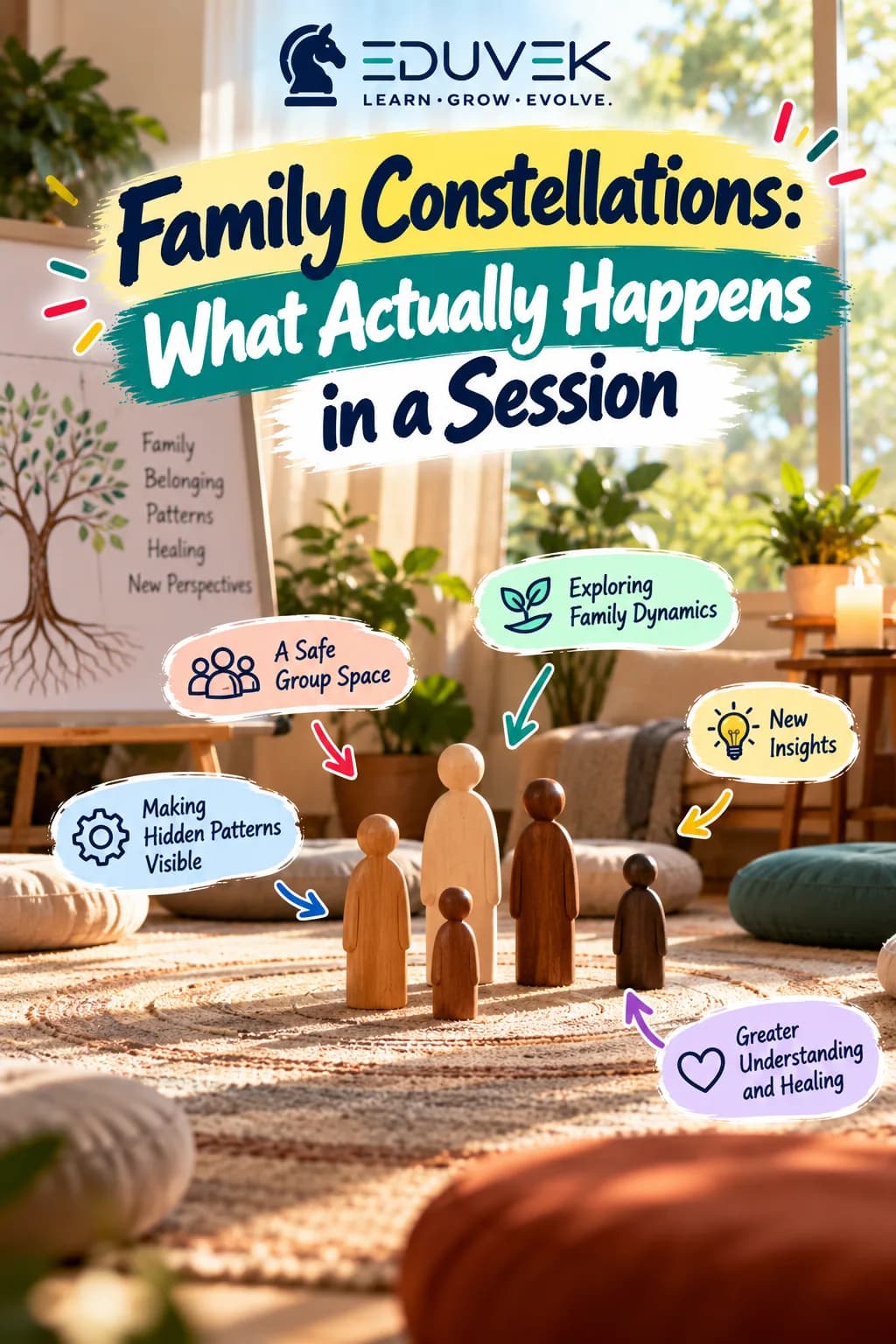
A family constellation is a session in which you look at your family system from the outside. You bring a question — something that keeps repeating, a relationship that doesn't work, a sense of being stuck — and the people and forces involved are represented in the room so you can see the shape of it rather than only feel it.
The format
In a group session, other participants stand in as representatives for members of your family. You place them in relation to one another according to your own sense of how things sit, and then you watch.
In a one-to-one session, the same thing happens with markers on the floor, figures on a table, or sometimes just paper — you and the facilitator move them, and you observe from outside the arrangement.
In both cases the facilitator guides what happens next: asking what you notice, suggesting a change of position, inviting a sentence to be spoken aloud. Sessions typically run between one and two hours.
What you actually do
Less than people expect. You describe your question, you set up the arrangement, and then mostly you look. Participants often report that seeing the configuration from outside is the part that lands — not being told anything, but noticing where someone is standing and realising it looks familiar.
You may be invited to say something directly to a representative. Some people find this affecting; others find it strange and say so. Both are normal.
What it isn't
It isn't therapy, and a facilitator is not a therapist unless they hold that qualification separately. It isn't diagnosis. It isn't a treatment for a mental health condition, and anyone presenting it as one is overreaching.
It's a reflective practice — a structured way of looking at family relationships — and it sits alongside professional support rather than replacing it. If you're dealing with something serious, that's a conversation for a doctor or a licensed therapist.
What people bring to it
Recurring patterns in relationships. Difficulty with a parent or sibling that hasn't shifted. A decision they can't seem to make. A sense of carrying something that doesn't feel like theirs. Often it's simply curiosity — someone has heard about the method and wants to understand it from the inside.
Does it work online?
Yes, and many facilitators now work this way. Instead of people in a room, the arrangement is made on screen using figures or positions, with the facilitator guiding it. Participants who've done both generally report that the one-to-one online version works well, and that large group sessions lose something without physical presence.
Before you book
Ask the facilitator how they work, how long a session runs, and what their background is. Ask what happens if you find it uncomfortable. A good facilitator will answer all of that plainly, and will tell you if what you're describing is better taken somewhere else.