
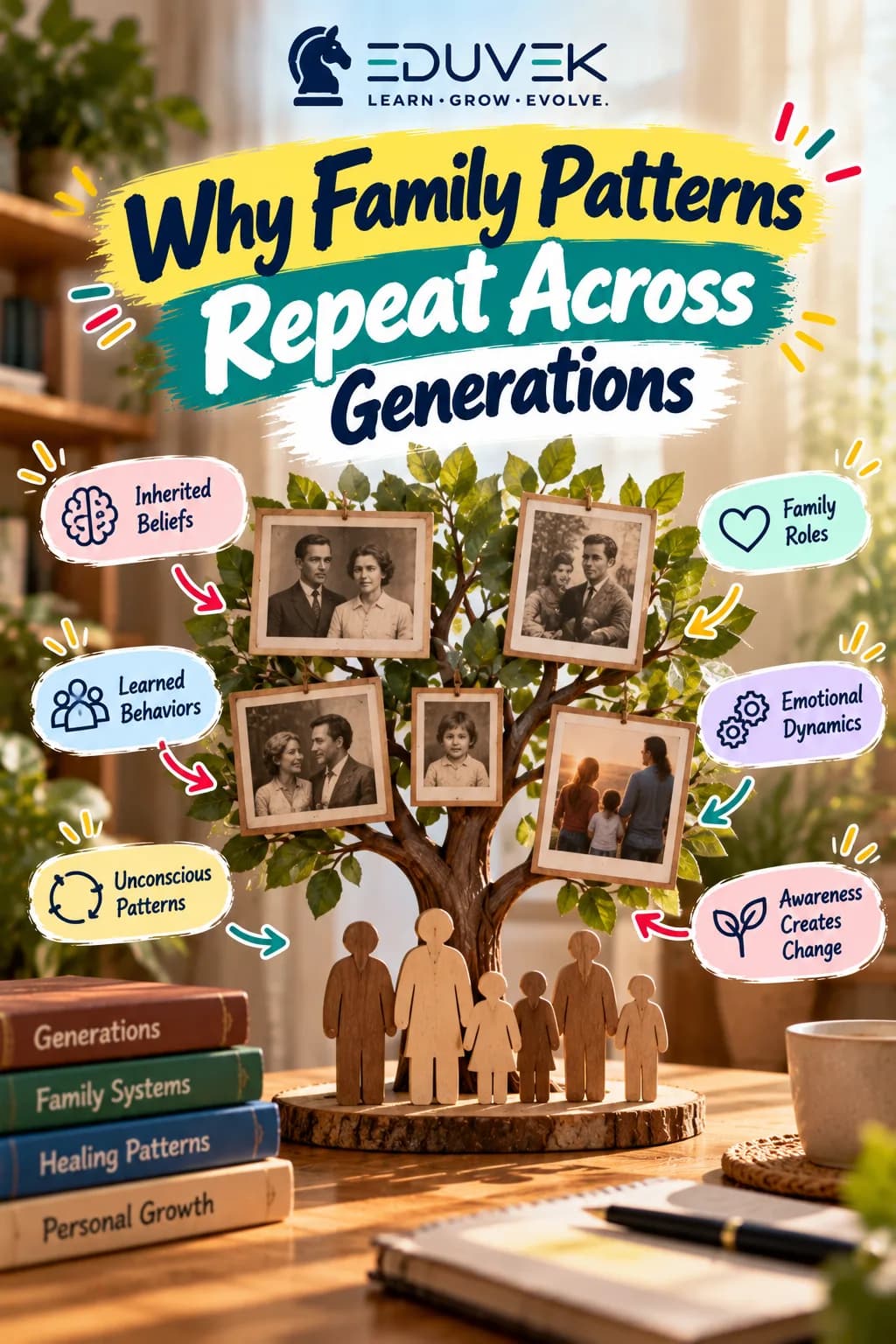
Families repeat themselves. The same arguments, the same roles, the same kinds of relationship chosen by people who swore they'd choose differently. It's one of the most commonly observed things in family life, and it has explanations that are far less mysterious than they first appear.
What gets handed down
Not traits, mostly. Behaviour.
You learn what a relationship looks like by watching one, long before you can evaluate it. You learn how conflict is conducted — whether people shout, go silent, or leave — from the only example you had. You learn what emotions are permitted in your family and which ones get a reaction.
None of that is chosen. It's absorbed in childhood and then enacted in adulthood, often by someone who would describe their family's way of doing things as exactly what they don't want.
The rules nobody states
Every family has rules that were never said out loud. We don't talk about money. We don't disagree with Dad. Nobody mentions what happened to your aunt. Achievement is how you earn attention here.
These are powerful precisely because they were never articulated — an unspoken rule can't be argued with, and most people don't notice theirs until they're in a family that has different ones.
Roles
Most families assign them, usually without meaning to: the responsible one, the difficult one, the peacemaker, the one who worries. Children take up a position in relation to whoever got there first, and those positions tend to persist into adulthood long after they've stopped being useful.
The pattern repeats partly because people recreate the role they know how to play, even when it costs them.
Why awareness matters more than effort
Deciding to be different rarely works on its own, because the pattern isn't a decision — it's a default that operates when you're tired, stressed or caught off guard.
What does tend to help is seeing it clearly: naming the rule, recognising the role, noticing the moment you're about to do the thing your parent did. That doesn't dissolve a pattern, but it introduces a pause where previously there wasn't one.
Where constellations come in
Constellation work is one way of looking at that shape from outside — arranging the family as you experience it and observing what becomes visible when it's in front of you rather than inside you.
It's a reflective practice rather than a treatment, and it's not the only way to do this. Therapy does it through conversation. Some people get there through writing, or through a long honest talk with a sibling. The common ingredient is looking directly at something that usually operates unexamined.