
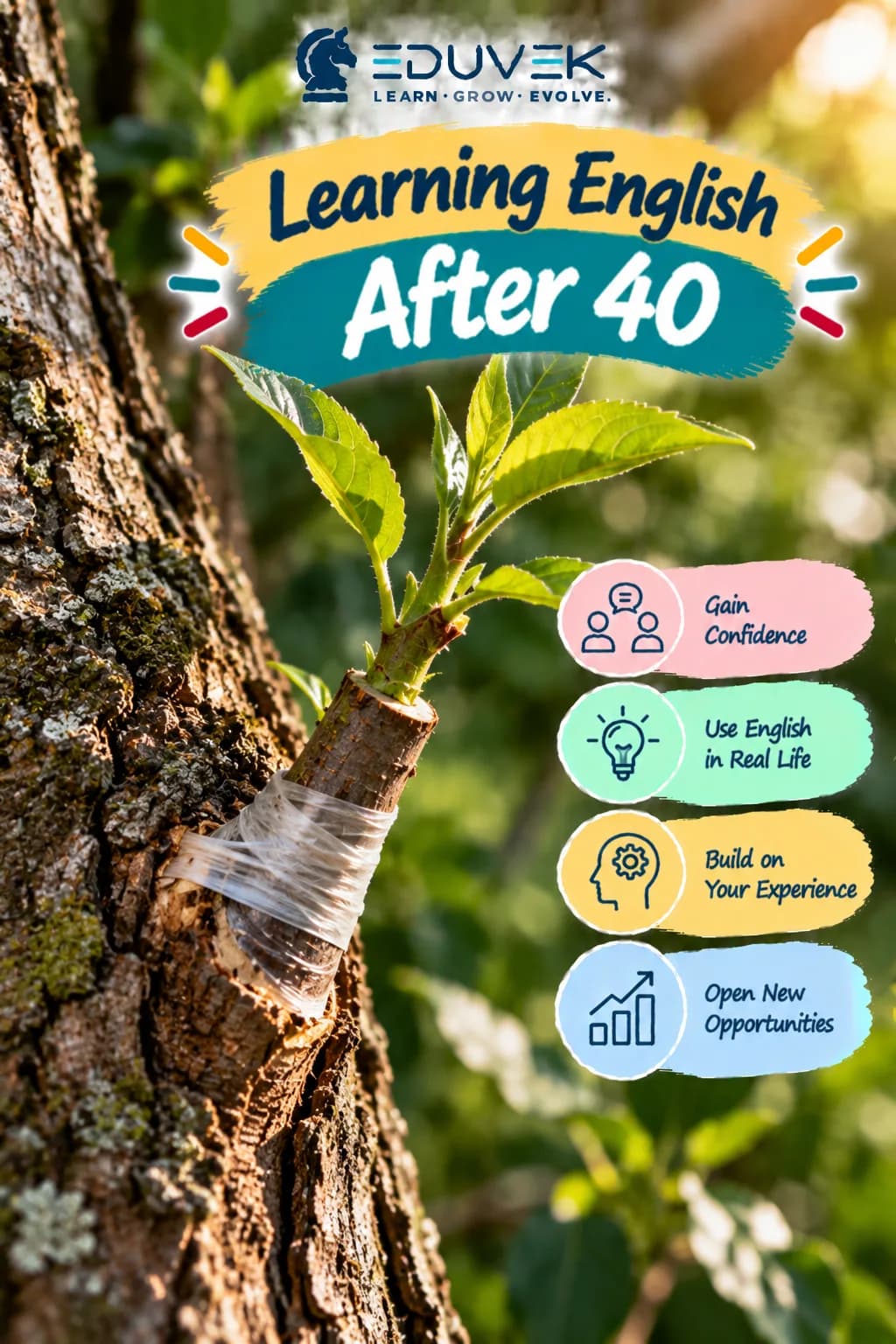
The belief that languages can only be learned young is widespread, discouraging and mostly wrong. Adults learn differently from children, and on most measures that matter for an adult's actual goals, they learn faster.
Where the myth comes from
Children do acquire one thing better: pronunciation. There's reasonable evidence that the ability to pick up a native-like accent declines with age, and most people who start as adults keep an accent for life.
That's the real finding, and it got generalised into "adults can't learn languages," which doesn't follow. An accent is not a barrier to fluency — it's a feature of how you sound. Millions of people work, present, negotiate and lead in accented English without difficulty.
What adults do better
Grammar explicitly. An adult can be told how a structure works and apply it immediately. A child has to infer it over years of exposure.
Vocabulary. You already have concepts, and you already know how learning works for you. You're attaching new labels to things you understand, which is far quicker than building both at once.
Strategy. Adults can identify what they need, choose material, measure progress and persist through a difficult stretch. Children cannot do any of that and don't need to.
Transfer. If you've learned any language before, including your own formally, you know what grammatical terms mean and what study feels like. That's a substantial head start.
Children appear to learn effortlessly partly because they have thousands of unhurried hours and no consequences for mistakes. Give an adult the same conditions and the comparison changes considerably.
What's genuinely harder
Not the learning. The circumstances.
Time, mostly — an adult has work, family and obligations, and fits study into gaps. Self-consciousness, which children largely lack and which is the single biggest brake on adult speaking. And the cost of error, since a child's mistakes are charming and an adult's feel professionally exposing.
Those are real difficulties, and they are about the situation rather than about capacity.
What works at this stage
Clear purpose. Adults do badly with open-ended study and well with a defined goal: handle meetings, pass an exam, talk to family, work in English. The goal shapes everything.
Speaking from early on. The self-consciousness gets worse the longer you delay. Speaking badly for six months is how you get to speaking well; waiting until you're ready extends the uncomfortable phase indefinitely.
Short and frequent. Twenty minutes most days beats three hours on a Sunday — for memory reasons, and because the Sunday session is the one that gets cancelled.
A teacher rather than only an app. Adults have fossilised errors, limited time and specific goals. All three argue for someone who corrects you and aims the work.
On pronunciation
Worth being clear, because this is where people lose heart. The goal isn't a native accent — it's being comfortably understood, which is achievable at any age and mostly comes down to stress, rhythm and the handful of sounds your first language doesn't contain.
The honest position
Starting at forty, fifty or sixty, you will probably always have an accent and you can absolutely become fluent. Those two facts coexist, and the first one matters far less than almost everyone assumes.