
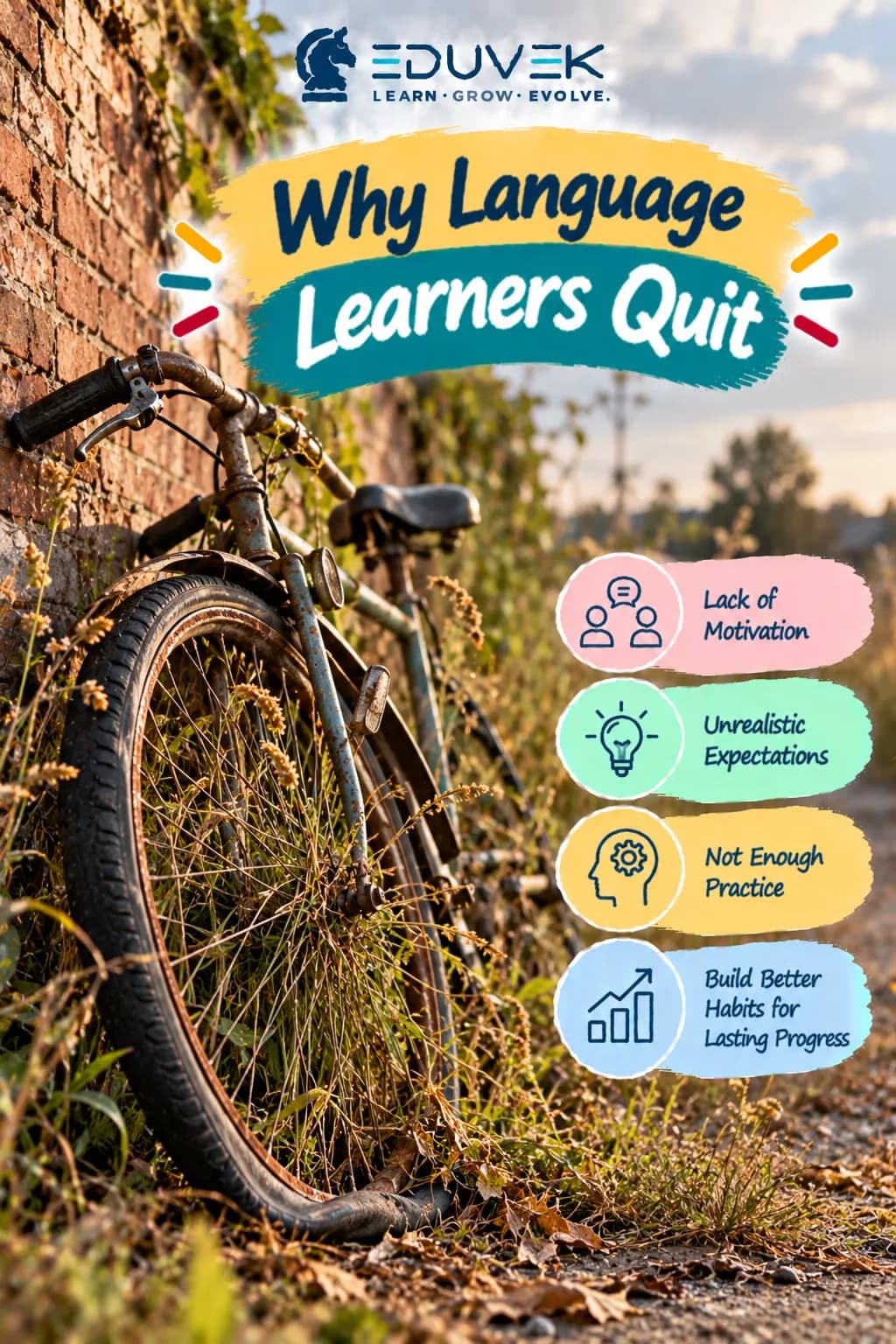
Almost nobody quits because they can't do it. They quit at predictable points for predictable reasons, and knowing where those points are is most of what it takes to get past them.
The first wall: around three months
The beginner surge ends. Early on, everything you learn is immediately useful and progress is obvious. By month three you've covered the basics, the gains have slowed, and you can't do much yet.
This is the gap between no longer being a beginner and not yet being able to use the language — and it's where most people stop, because effort has gone up and visible progress has gone down at the same time.
The second wall: the plateau
For those who continue, the harder one. Intermediate is comfortable, functional, and apparently permanent. Months pass with no detectable change.
People quit here not from frustration but from drift. Nothing dramatic happens; study just quietly stops being a priority and then stops.
The reasons underneath
No real goal. "Improve my English" can never be achieved, so it can't be progressed against. Without a specific target there's no feedback, and without feedback motivation has nothing to run on.
Measuring the wrong thing. Streaks, hours and lessons completed measure attendance. It's entirely possible to have excellent numbers and no new ability, and when someone notices that gap, the numbers stop being motivating.
Studying alone. Nothing is expected of you, nobody notices if you stop, and no one tells you whether you're improving. Solo study survives on willpower, and willpower is finite.
The comparison problem. Measuring yourself against people who grew up bilingual, or against your own first language, guarantees a sense of failure regardless of actual progress.
One bad experience. A conversation that went badly, a colleague who looked confused, a joke you didn't catch. People frequently stop speaking after a single embarrassing moment and then stop learning, because the speaking was the engine.
What keeps people going
A goal with a date. An exam, a trip, a presentation, a conversation with specific people. Something that finishes.
Someone expecting you. The most reliable factor by a wide margin. A scheduled hour with a person is kept; a private intention is not. This isn't about discipline — it's about which commitments survive a bad week.
Measuring output. Can you do something now you couldn't three months ago? That's progress. Hours studied is not.
Permission to be bad at it. The learners who continue are the ones who treat an awkward conversation as the cost of learning rather than as evidence about themselves.
If you've already quit
Most people who speak a second language well quit at least once. A gap of a year is not a loss of what you knew — it comes back considerably faster than it went in.
The useful question isn't how to restart with more discipline. It's which of the reasons above ended it last time, because that one will end it again.