
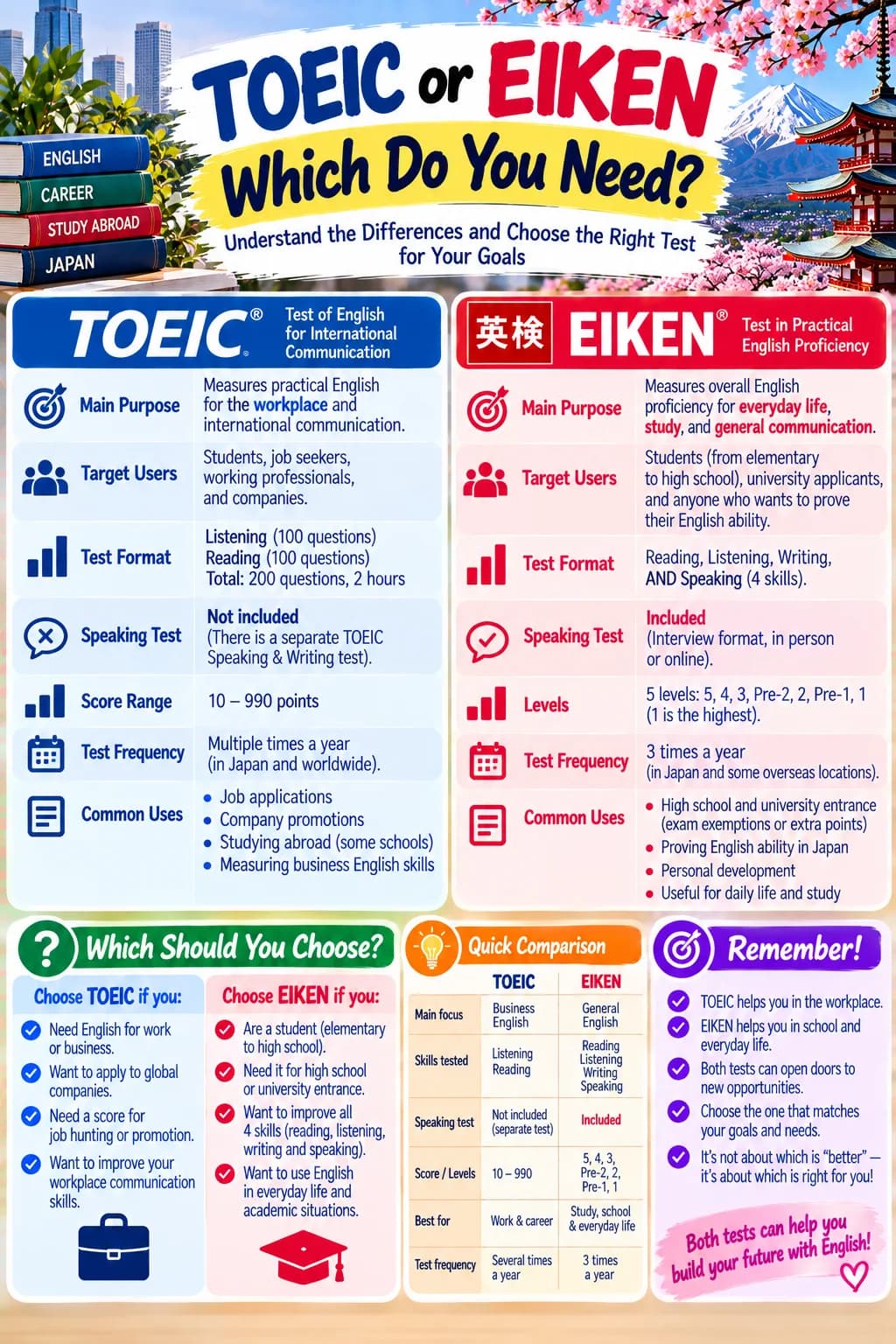
TOEIC and Eiken are the two English tests most Japanese learners weigh up, and choosing between them matters, because the right one depends entirely on what you need it for. Prepare for the wrong one and you can lose months.
The short version
TOEIC is built around workplace and everyday English and is the score most Japanese companies ask for. Eiken is a graded, step-by-step qualification that schools and universities recognise and that tests a fuller range of skills. Neither is "better" — they're built for different purposes, and plenty of learners end up taking both at different stages of their lives.
What TOEIC measures
The version most people mean by "TOEIC" is the Listening & Reading test — a two-hour, multiple-choice paper focused on business and daily-life situations, reported on a 10–990 score scale. There are also separate Speaking & Writing tests, but many companies ask only for the L&R score. Because it's a single scaled number, TOEIC is easy for an employer to set a bar with — "we want 700+" — which is exactly why it dominates hiring, promotion, and transfer decisions in Japanese companies.
What Eiken measures
Eiken (実用英語技能検定) is organised into eight graded levels — from Grade 5 up to Grade 1, including Pre-2 Plus — and you sit the grade you're aiming for. From Grade Pre-2 upwards, the test runs in two stages — reading, writing and listening first, then a six-minute in-person speaking interview. Grades 5 and 4 are single-stage, with an optional four-minute online recorded speaking test. That four-skill picture at the higher grades is why Japanese schools and universities recognise Eiken as proof of ability.
Choose by your goal
If you need English for a job, a promotion, or a company requirement, TOEIC is almost certainly what they'll ask for — prepare for that. If you're a student, heading to university, or want recognised all-round proof that includes speaking and writing, Eiken fits better and gives you a clear ladder to climb. If you're not sure, ask the specific school or employer what they accept before you spend a yen on preparation — the answer decides everything.
The test is not the skill
A score opens a door, but it doesn't make you fluent, and it's easy to drill test technique while your actual speaking stays frozen. Prepare for the format you need — learn the question types, practise under real time pressure, and do full timed sections — but keep using English for real alongside it. This is especially true for Eiken's speaking interview, which is the part self-study leaves weakest and where practising with a real person makes the biggest difference.
How to prepare well
Know the exact format cold so nothing on test day is a surprise. Build stamina with full-length timed practice, not just isolated questions. For TOEIC, train listening with workplace-style audio and learn to manage the clock on the reading section. For Eiken, rehearse the interview out loud with someone who can push back and correct you. And start earlier than feels necessary — both tests reward steady preparation far more than a last-minute sprint.