
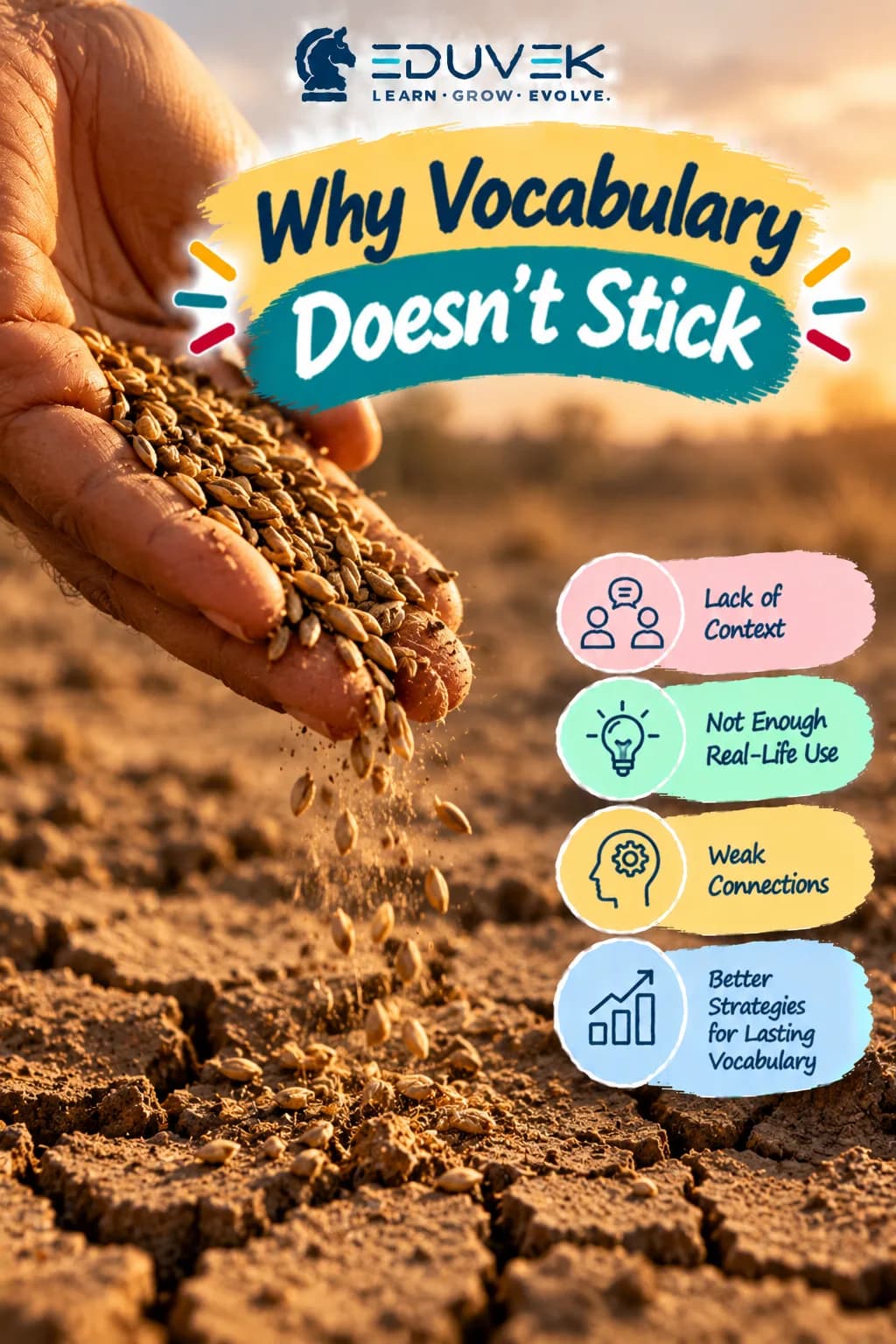
You looked the word up. You wrote it down. You recognised it on the flashcard three times. And when you needed it in a conversation, it wasn't there. This is the single most common frustration in language learning, and it happens because of a specific mismatch between how most people study vocabulary and how vocabulary is actually used.
Recognition is not recall
When you see a word and remember what it means, that's recognition. When you need a word and produce it from nothing, that's recall.
These are substantially different, and practising the first builds very little of the second. A flashcard app showing you reluctant and asking what it means trains you to understand it in a text. It does almost nothing for your ability to say it when you need it.
Most study is recognition practice. Most of what people want is recall.
Words don't live alone
You didn't learn vocabulary in your first language as single items. You learned words inside phrases, attached to situations, with a sense of what goes with what.
A word stored alone is nearly unusable. You know reluctant means unwilling, and you still don't know whether you're reluctant to do something or reluctant of doing it, whether it's formal, or whether anyone actually says it.
Learning the phrase instead of the word solves most of this: reluctant to admit it, not reluctant. Slightly more to remember, enormously more usable.
Forgetting is part of the process
People treat forgetting as failure. It isn't — the brain discards what it hasn't needed, and a word encountered once and not used again is correctly identified as unimportant.
What makes a word stick is retrieving it after you've partly forgotten it. That mild effort of reaching for something half-gone is what consolidates it, which means the uncomfortable part of the process is the part doing the work.
Why you remember some words effortlessly
Think of a word you learned once and never forgot. It almost certainly came with a situation: someone said it to you, you misunderstood something, it was funny, you needed it urgently.
That's not sentimentality — it's how memory works. Words attached to an event have far more to hold onto than words on a list.
Which is the real argument against studying vocabulary in isolation: not that it's ineffective, but that conversation generates the attachments automatically and a list cannot.
What to do instead
Learn phrases. Three or four words at a time, as a unit.
Use it within a day. A word you've used in a real sentence to a real person has a different status from one you've reviewed.
Keep a short list, not a long one. Ten words you intend to use beats two hundred you'll recognise.
Accept the first attempt will be clumsy. Using a new word slightly wrong is how it becomes yours. Waiting until you're sure is how it stays on the list.
The uncomfortable summary
Vocabulary doesn't stick because it's being stored for recognition and needed for production. The fix isn't more study — it's using fewer words more often, out loud, with someone who'll tell you when it lands wrong.