
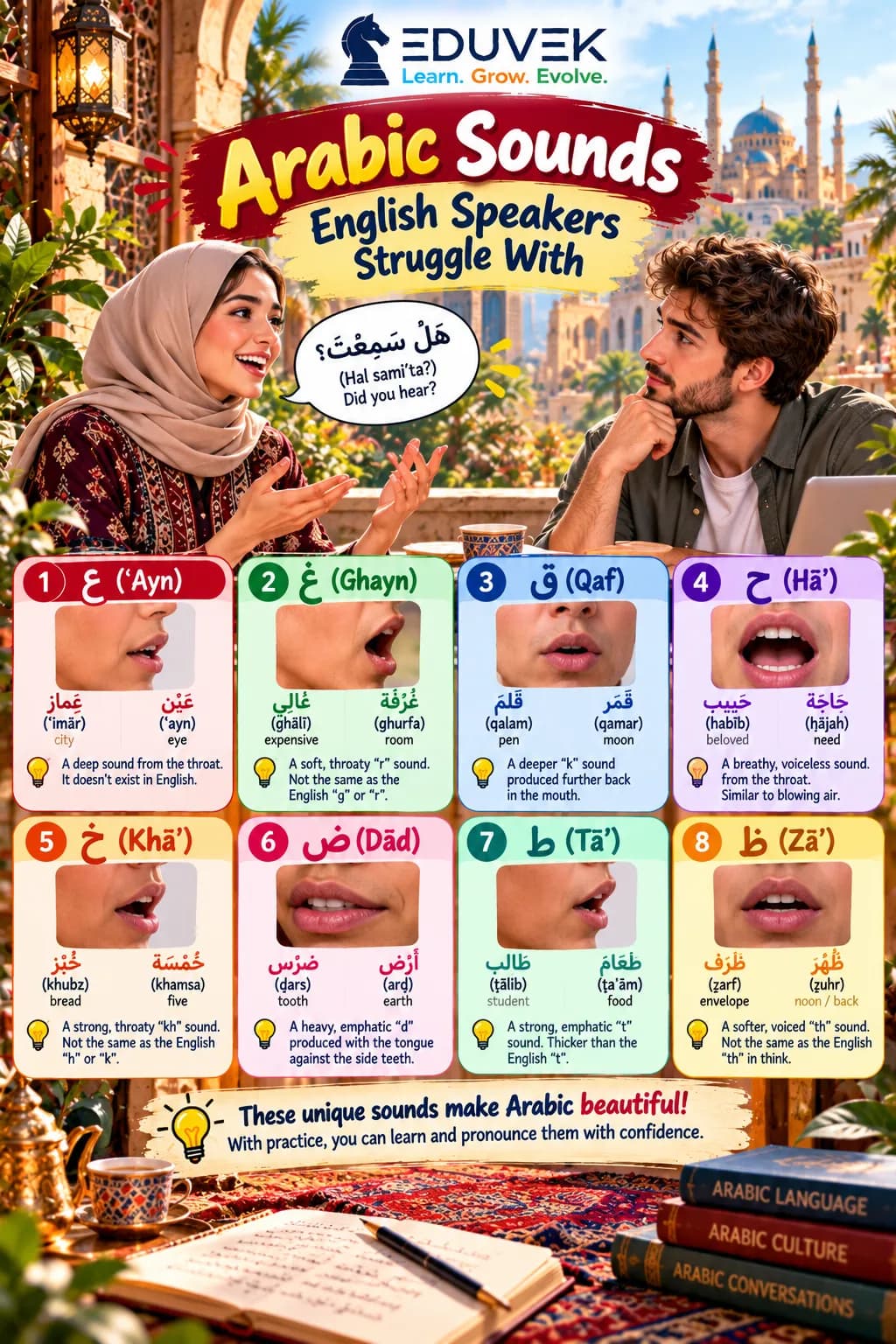
Most of Arabic's sounds are manageable; a small set are genuinely new to an English mouth, and they're worth meeting head-on.
The sounds with no English equivalent
A few give everyone trouble: ʿayn (ع), the deep ḥ (ح), the throaty q (ق) and ghayn (غ), and the "emphatic" consonants that darken the vowels around them. None of these map cleanly onto an English sound.
Why they're hard
They're produced further back in the throat than any English sound, so there's no muscle memory to borrow. It's a physical skill more than a listening problem — your mouth has to learn a new move.
The distinctions that matter
Some of these carry meaning: telling ḥ (ح) from a plain h, or q (ق) from k, can change a word. That's why they're worth practising rather than quietly replacing with the nearest English sound.
How to approach them
Imitate a native speaker in short bursts, expect it to feel strange at first, and accept "close enough" early while you build the muscle over weeks. The goal is steady progress, not instant mastery — and being understood doesn't require perfection.