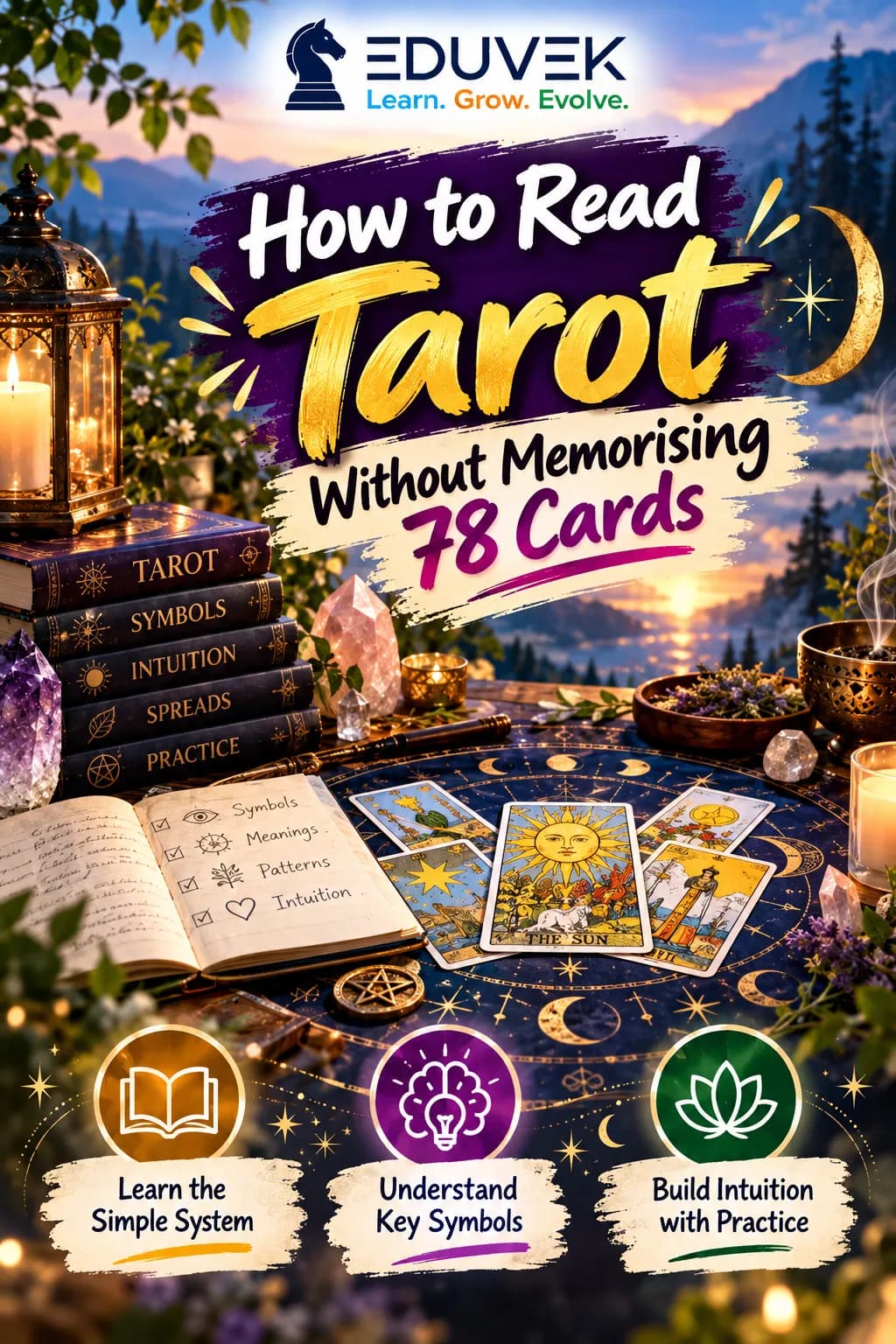
The single biggest thing that stops beginners is the belief that they must memorise 78 fixed meanings before they can read at all.
You don't — and reading from rote definitions is usually the worst way to start.
Read the picture first
Before any book definition, describe what you actually see: the scene, the mood, the colours, where your eye is drawn, what the figure seems to be doing. For most cards, that description is the meaning in miniature.
Tarot is a visual, interpretive practice; the image comes first.
Use the structure as scaffolding
The deck has a logic that lets you reason your way to a card's sense without memorising each one. The Major Arcana point to big life themes; the Minor Arcana to everyday texture.
The four suits are commonly read as reflective areas — Cups often around feelings and relationships, Pentacles the material and practical, Swords thoughts and clarity, Wands energy and drive — but readers differ, and part of learning tarot is building your own sense of each suit rather than inheriting fixed meanings. Numbers trace a progression from beginnings (aces) toward completion (tens), and the court cards suggest people or approaches.
Knowing this scaffolding means a "Five of Cups" isn't a definition to recall — it's emotion + the tension of a five, which you can interpret.
Let position and question do the work
The same card means different things depending on what you asked and where it falls in a spread. Meaning is contextual, not a lookup — a card about rest reads one way over "my work" and another over "my health." Interpretation is reflection in context.
When to use the book
Use a guidebook as a prompt to compare against your own read — "here's what I saw; here's what the book suggests; what's the gap telling me?" — not as a rulebook. Over time you build your own working vocabulary, and that personal read is what makes tarot a reflective practice rather than a memory test.
You can start reading interpretively today, with imagery and structure rather than flashcards. As throughout, this is reflection — a way to think a situation through — never prediction.