
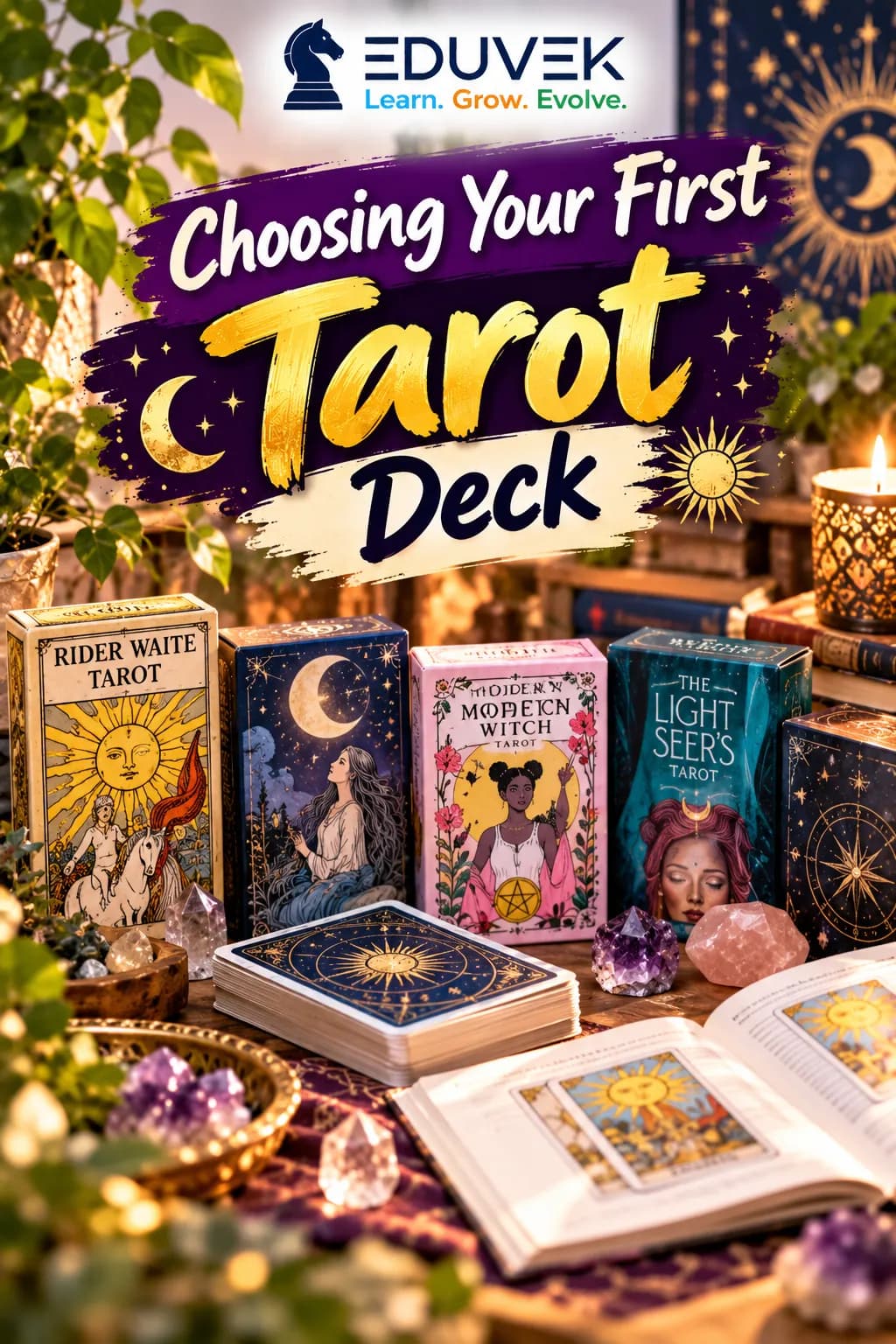
The deck matters less than beginners fear, but a well-chosen first deck genuinely makes learning easier — mostly because of how its cards are illustrated.
Why beginners are often pointed to the Rider–Waite–Smith
In the RWS deck (and its many clones), every card has a full illustrated scene — including the number cards, which show little tableaux rather than just "five cups" arranged on a blank background. That matters enormously for the interpretive, read-the-picture approach: a scene gives you something to read; a bare arrangement of symbols doesn't.
Most guides and courses also reference RWS, so you'll find more support as you learn.
Modern and art decks: the trade-off
There are gorgeous modern and art decks, and personal resonance with the images is a real advantage — you'll reach for a deck you love. But some minimalist or abstract decks give the number cards only pips (five plain cups), which leaves a beginner with far less to interpret.
If you fall for a modern deck, check that its minors are fully illustrated with scenes.
Practical things to check
A few things make a first deck easier to live with:
- Fully illustrated minor cards (scenes, not bare pips).
- A small guidebook included.
- Card size and stock you find comfortable to shuffle and handle.
- Imagery you're genuinely happy to sit with — you'll be looking at it a lot.
Ignore the myths
You do not have to be "gifted" your first deck by someone else, and no deck is more "real" than another — buy your own, today, without ceremony.
Pick a deck whose images speak to you and whose number cards tell little stories — then the deck quietly teaches you to read, and the skill transfers across every deck you'll ever own.