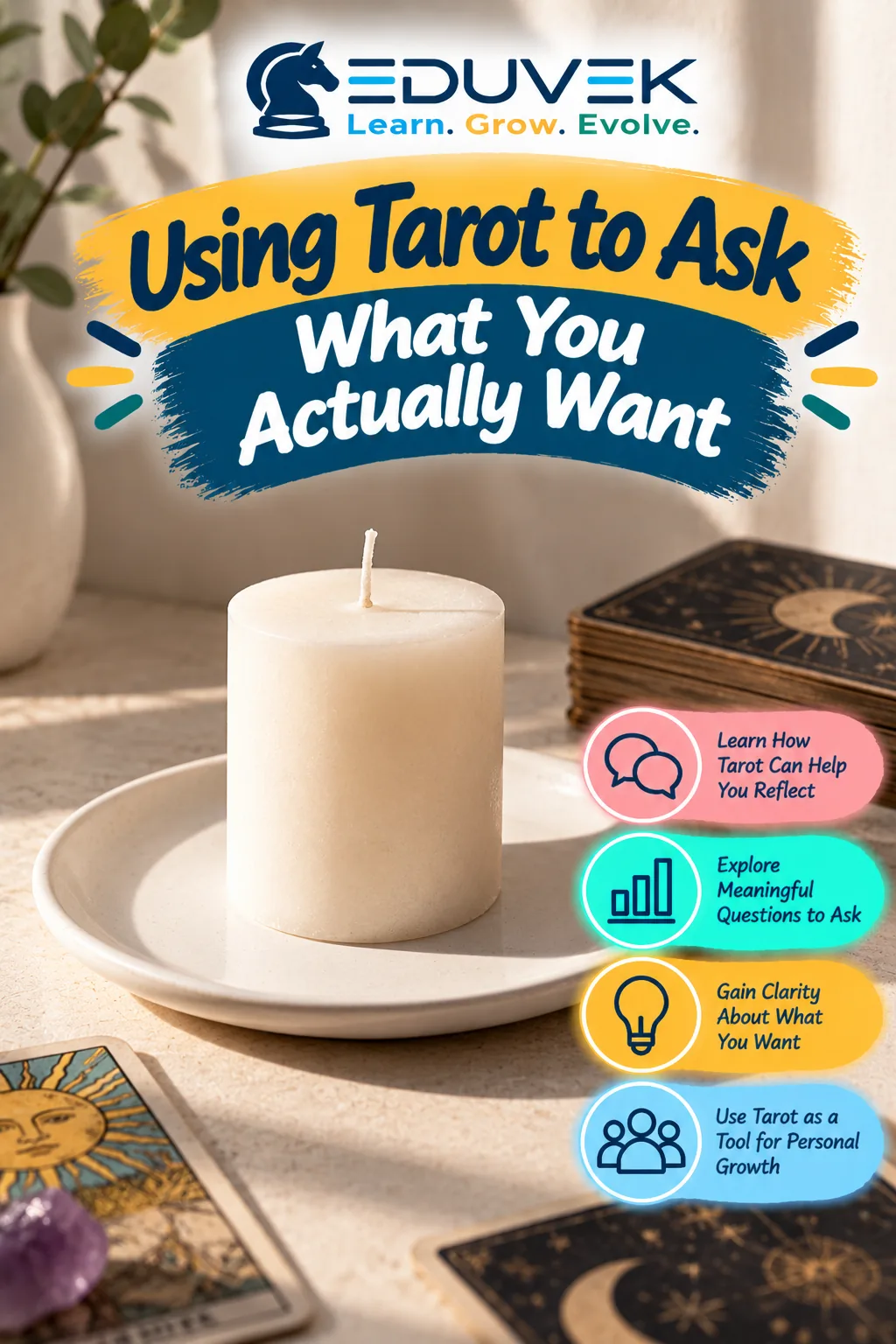
There's a question some people genuinely can't answer: what do you want. Not in the sense of refusing to say, but in the sense of looking inward and finding nothing there to report. Tarot is sometimes useful here, for a reason that has nothing to do with prediction.
Why the question is hard
If you've spent years organising yourself around other people's preferences, your own stop being available. Not hidden — unpractised. The question what would you like produces a blank, or produces an answer about what would be easiest for everyone.
Asked directly, it tends to stay blank. The direct approach is the one that hasn't worked.
What a card actually does here
It gives you something to react to.
Instead of generating an answer from nothing, you're responding to an image — and responses are much easier to access than intentions. You look at a card, something in it strikes you as apt or wrong or uncomfortable, and that reaction is information you didn't have thirty seconds earlier.
That's the mechanism, and it's not mysterious. It's the same reason it's easier to edit a draft than to write one, or to answer a specific question than an open one.
How this is different from a reading about the future
Entirely different. Nothing here involves the cards knowing anything.
The card is a prompt. Its traditional meanings give you a vocabulary and a starting point, and what you do with it is reflection. If you find yourself arguing with a card, that's the useful part — you've just discovered a position you hold.
A way to use it
Ask something specific rather than general. Not what do I want, which is the question you can't answer, but what am I avoiding asking for or what would I choose if nobody minded.
Draw one card. Not a spread — one. Sit with it longer than feels necessary.
Then write down your reaction rather than the card's meaning. The reaction is the content.
What to watch for
The pull toward a reassuring interpretation. If you have a habit of accommodating, you may well read the card in whichever way asks least of you.
Noticing that you've done this is itself useful, and it's one of the reasons working with another person occasionally is worth more than only working alone.
What this isn't
Tarot doesn't diagnose anything, doesn't predict anything, and isn't therapy. It's a reflective practice — which is how Miriam's other articles describe it too, and it's the honest description.
If what you're working on is heavy — a relationship that's harming you, persistent low mood, something following a frightening experience — that belongs with a licensed therapist. A deck is not equipped for it and shouldn't be asked to be.
Why it suits this particular question
Because the question resists being asked head-on, and an indirect route sometimes works where the direct one doesn't.
That's a modest claim. It's also, for a lot of people, the difference between an hour of staring at a blank answer and an hour where something surfaced.