
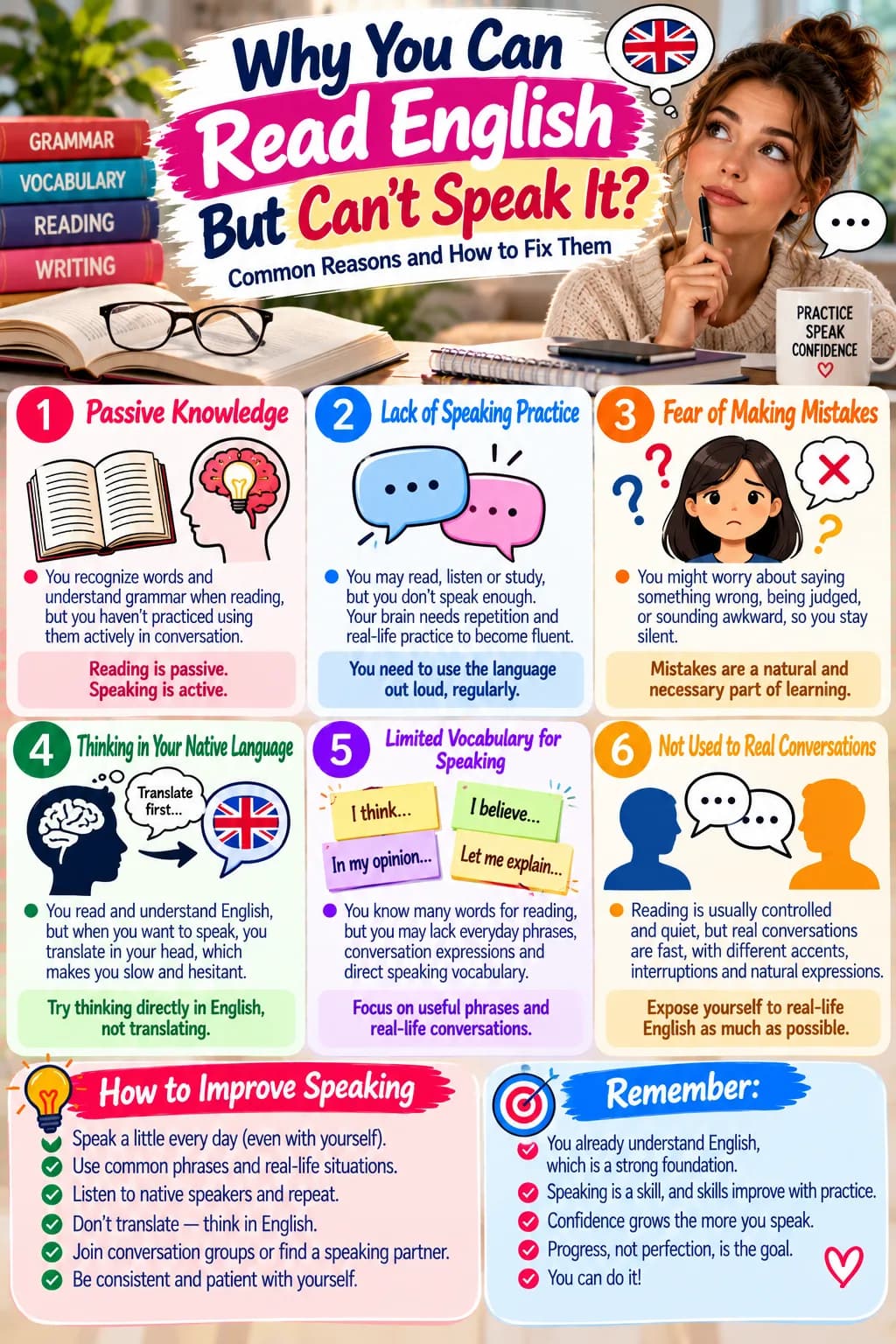
If you can read an English article or pass a written test but freeze when you have to speak, you are not unusual and you are not stuck. For Japanese learners this gap is one of the most common experiences there is — and it has a clear, specific cause.
It starts with how English is taught in Japan
For generations, school English has centred on yakudoku — reading English and translating it into Japanese, with grammar studied for written entrance exams rather than conversation. That system produces excellent readers: you can decode sentences, recognise grammar, and handle a written test. What it rarely builds is production — generating English out loud, in real time, with a real person. The gap you feel isn't a personal failing; it's the predictable result of years spent practising one skill and almost never the other.
Reading and speaking are genuinely different skills
Reading is receptive — you recognise words someone else already chose, at your own pace, with the option to re-read. Speaking is productive — you generate the words yourself, live, with no pause button and someone waiting. These are trained separately in the brain, which is why one can race far ahead of the other. Strong reading is real evidence of how much English you already have; it simply hasn't been connected to your mouth yet.
Translating in your head is the bottleneck
The habit school built — build the sentence in Japanese, translate it to English, then say it — is far too slow for conversation, and it tends to collapse halfway through a sentence. Fluency comes from thinking in small English chunks you can reach for whole — I think so, by the way, do you mean…, let me check — instead of assembling every sentence from grammar rules under pressure. You already met these chunks while reading; speaking is about pulling them forward into instant use.
Confidence is the other half — and it's beatable
On top of the training gap sits the fear of getting it wrong, which for many learners is the thing that actually locks the words in. The short version: mistakes are how speaking improves, "communicated" beats "correct," and your vocabulary is almost always bigger than your confidence. The freeze itself — understanding perfectly yet going blank when it's your turn — is worth understanding in its own right, and my colleague Dr. Sarah Langridge covers it in depth in Why You Understand English But Freeze When You Speak, linked under Related articles below. Read that alongside this one.
How to close the gap
The fix is output, not more input. Reading more English will not, on its own, teach you to speak it — only speaking does that. Practise out loud at low stakes: talk to yourself, narrate your day, read passages aloud, and get regular one-to-one speaking time where mistakes are safe and corrected gently. Lean on memorised chunks, let small errors pass without stopping, and treat every short conversation as a rep. The reading you already have is an asset, not the problem — speaking just turns that recognition into production, and that only happens by doing it.